What Cursor shipped on November 5, 2026
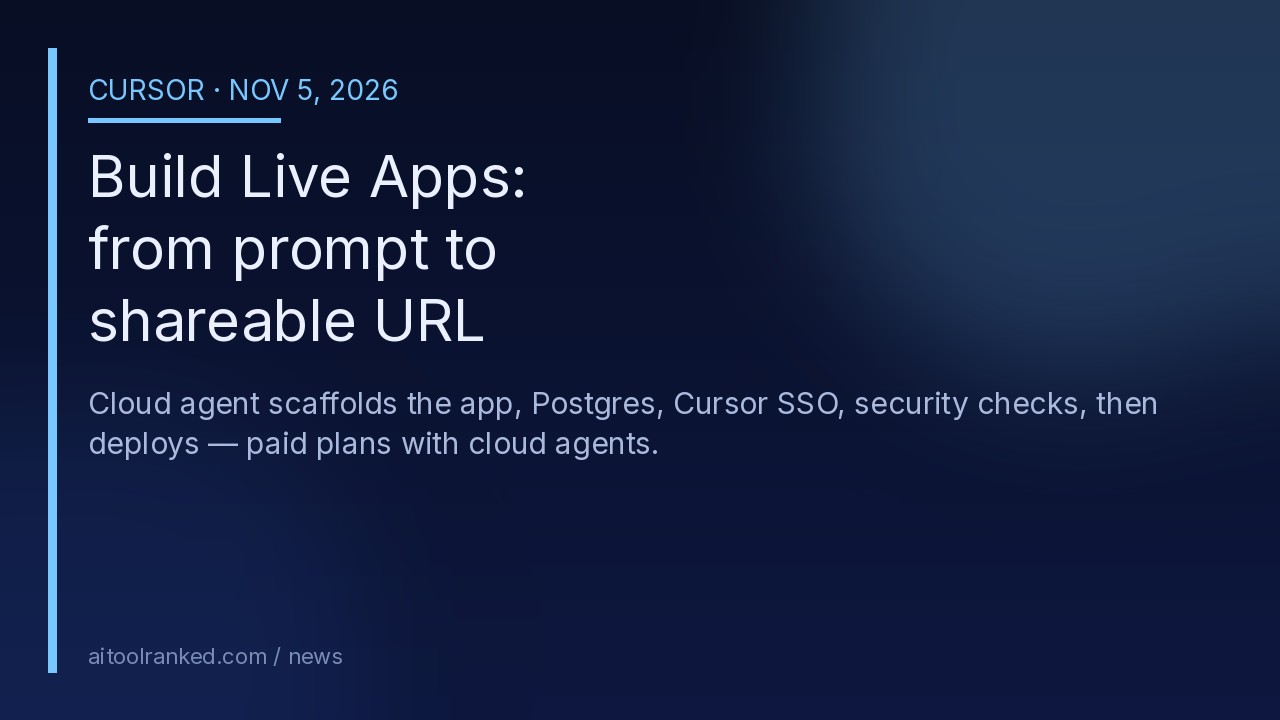
Cursor published Build Live Apps in Cursor ↗ on November 5, 2026, with matching docs under Cloud Agent → Apps ↗.
The product bet is blunt: agents already cut the cost of writing code, but most of those tools die on localhost. Build Live Apps is Cursor’s answer — describe the tool, kick off a cloud agent (not a local session), and Cursor handles scaffold, optional database, auth, security review, and hosting until you explicitly publish a live URL.
Dated facts from Cursor’s own changelog and docs:
Cloud agent only — you must tell the agent you want to build an app; the feature is not supported in a local agent session.
Scaffold + infra — Cursor builds the web app, can spin up a Postgres database when needed, puts private/team apps behind Cursor SSO, and provisions hosting in a dedicated account isolated per team or individual plan.
Secrets — if the app needs a warehouse or other system, Cursor prompts for secrets; the docs say the agent never sees the secret values. Team admins usually create team secrets in the Apps dashboard.
Publish gate — you pick a unique domain; Cursor runs deterministic and agentic security checks (secrets in files, credential files, .env, source maps, plus an AI security review). Nothing goes live until checks pass and you choose to publish.
Sharing — invite people/groups, whole team (signed into Cursor), or public on individual plans. Public sharing is off by default for Teams/Enterprise; admins can enable it.
Admin controls — team admins see every app and secret, can add custom security-review rules, approve blocked publishes (except malicious code / hardcoded secrets / exposed credentials), unpublish any app, and toggle Apps / public apps / API-key access. Changes land in the audit log.
Repos — available on all paid plans with cloud agents enabled. Docs also document x-cursor-app-token API keys so scripts or Grok Bot can call private/team apps without a browser sign-in.
Repos / hosting — Cursor can deploy from new or existing repos on Cursor Origin and GitHub; GitLab “coming soon.” Hosting is described as separate from Cursor’s core services and provided as-is.
Internal examples Cursor names (their own org): ops tools (event registration, account assignments, desk seating), multimedia customer presentations, new-hire onboarding, sales pipeline dashboards, engineering-service portals.
What people are saying on X
Official launch post (~3.7k likes / ~464k impressions at research time):
“You can now build live apps in Cursor and share them with a link.
Agents have made it easier to write code, but most apps never make it off localhost. Describe the tool you want - Cursor will build it, set up a database, run deterministic and agentic security checks, and deploy.”
— @cursor_ai ↗
Reaction that frames the “works on my machine” tax:
“Cursor just killed "it works on my machine"
You can now build live apps in Cursor and share them with a link
Agents made it easier to write code, but most apps never made it off localhost. That changes now
Describe the tool you want. Cursor builds it, sets up a database if you need one, runs deterministic and agentic security checks, and deploys it. You pick the URL, publish when you're ready, and get a live link anyone can open
Nothing goes live before you choose to publish”
— @XFreeze ↗
Deploy-layer read (not just codegen):
“Build an app with an agent in ten minutes, then burn two hours getting it off your laptop and onto a real URL. That ratio is the actual tax on vibe coding right now, and Cursor and Vercel both shipped against it this week, two days apart.”
— @stretchcloud ↗
Our take: who should care
Non-engineer / ops builders inside Cursor shops: if your team already pays for cloud agents, this is the shortest path from “we need a seating chart / signup form / pipeline board” to a URL teammates can open behind Cursor sign-in — without waiting on a platform ticket.
Engineering leads evaluating vibe-coding risk: the interesting part is not the scaffold. It is the publish gate (deterministic + agentic checks, admin unpublish, audit log) and the default that Teams/Enterprise public sharing is off. Compare that posture to Replit / Lovable / v0-style publish flows before you green-light non-engineers hitting Publish on agent-written apps.
Vs other agent products on this desk: Mistral Studio managed agents is an enterprise control plane with private-cloud / on-prem gates; Perplexity Teammates is a Max-tier work agent product; Build Live Apps is IDE-native prompt → hosted internal/public app for Cursor paid users. Different buyer, different lock-in (Cursor SSO + Cursor hosting account).
Action this week: update Cursor, enable cloud agents if they are off, ship one team-visibility ops tool (not public) and walk the security-review failures once so you know what the gate actually blocks. Hold public apps until an admin policy exists.
For editor comparisons see GitHub Copilot vs Cursor 2026. For coding assistants see best AI for coding 2026. For agent stacks see best AI agent frameworks 2026.
AdSense-safe note: we are documenting Cursor’s published Apps feature and how to evaluate the publish / SSO / admin gates — not an upsell for any paid Cursor plan.
Sources