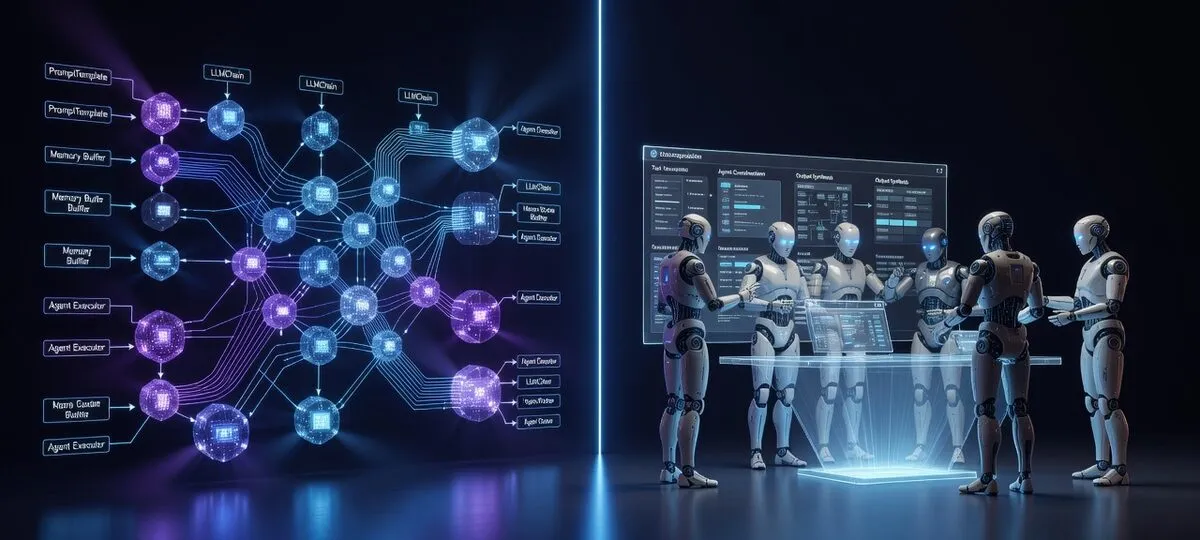
AI agent frameworks are mostly Python-centric libraries that help developers build autonomous systems capable of multi-step reasoning, tool usage, and collaborative problem-solving. Many frameworks compete for developer mindshare in 2026, led by LangChain/LangGraph and CrewAI, while Microsoft has moved AutoGen and Semantic Kernel users to its new Microsoft Agent Framework, and OpenAI has replaced its experimental Swarm with the OpenAI Agents SDK.
What are AI agent frameworks in 2026?
AI agent frameworks are mostly Python-centric libraries that help developers build autonomous systems capable of multi-step reasoning, tool usage, and collaborative problem-solving through orchestrated AI agents working together toward complex goals.
The AI agent frameworks market in 2026 has matured significantly since the experimental AutoGPT era. Established frameworks now offer vendor backing, broad tooling ecosystems, and dedicated features for running agents in production.
LangChain is one of the most widely used frameworks, with 1000+ integrations and the LangGraph extension for stateful workflows. In the 2025 Stack Overflow Developer Survey ↗, 32.9% of developers building agents used LangChain for orchestration, second only to Ollama. CrewAI is popular for prototyping with its intuitive role-based approach. Microsoft's AutoGen brought conversational multi-agent orchestration, but as of September 2026 it is in maintenance mode, and Microsoft points new users to Microsoft Agent Framework.
OpenAI released Swarm as an experimental, educational framework for lightweight agent handoffs. Swarm has since been replaced by the OpenAI Agents SDK ↗, which OpenAI describes as the production-ready evolution of Swarm. This handoff-based approach resonates with developers seeking straightforward multi-agent systems without heavy infrastructure requirements.
Nearly all major frameworks offer free, open-source core functionality. Revenue models center on cloud services (CrewAI's hosted platform), observability tools (LangSmith), or enterprise support rather than framework licensing.
AI agent frameworks in 2026 fall into three primary categories:
Workflow Orchestrators: LangChain/LangGraph and Microsoft Agent Framework (successor to Semantic Kernel) focus on complex, stateful processes with checkpointing and error recovery. These frameworks target enterprise scenarios requiring reliability and auditability.
Multi-Agent Crews: CrewAI and AutoGen specialize in role-based collaboration. CrewAI's sequential/hierarchical task delegation works well for content creation and research workflows. AutoGen's conversational approach suits scenarios requiring emergent agent behaviors.
Specialized Solutions: LlamaIndex focuses on RAG and document-heavy applications, while smolagents from Hugging Face offers a minimal library for code-writing agents. These frameworks trade generality for depth in one area.
Simple automation tasks work well with the OpenAI Agents SDK or basic LangChain agents. Complex business processes requiring state management and error recovery are better served by LangGraph or Microsoft Agent Framework.
How do the top AI agent frameworks compare in 2026?
There is no independent, public benchmark that compares these frameworks head to head on latency, cost or success rate, because results depend mostly on the model, prompts and tools you use. The practical differences are in architecture, language support, maintenance status and ecosystem.
Framework overhead is usually small compared with LLM API latency and token cost, so the model and prompt design dominate real-world performance. The table below compares the frameworks on verifiable characteristics instead:
| Framework | Maintainer | Languages | License | Status (Sept 2026) |
|---|
| LangChain/LangGraph | LangChain | Python, JavaScript/TypeScript | MIT | Actively developed |
| CrewAI | CrewAI | Python | MIT | Actively developed |
| AutoGen | Microsoft | Python, .NET | MIT (code) | Maintenance mode; successor is Microsoft Agent Framework |
| Semantic Kernel | Microsoft | C#, Python, Java | MIT | Succeeded by Microsoft Agent Framework 1.0 |
| AutoGPT | Significant Gravitas | Python/TypeScript platform | Polyform Shield (platform) | Now the AutoGPT Platform (hosted or self-hosted) |
CrewAI describes itself as an open-source Python framework with high-level abstractions for Crews (role-based agent collaboration) and Flows (event-driven workflow control). AutoGen, by contrast, will not receive new features and is community managed going forward.
State Management: LangGraph offers built-in persistence through checkpointers for long-running processes, and Microsoft Agent Framework provides workflow orchestration for production use. CrewAI provides state handling through Flows. AutoGen relies mainly on conversational memory.
Integration Ecosystem: LangChain lists 1000+ integrations, including vector stores such as Pinecone and Weaviate and major cloud services. CrewAI offers built-in tools for common tasks. AutoGen provides extensions but may require custom integration work for some external services.
Multi-Language Support: Semantic Kernel supports C#, Python and Java, and its successor Microsoft Agent Framework supports Python and .NET, which matters for .NET enterprise environments. LangChain has an equivalent JavaScript/TypeScript library, LangChain.js. CrewAI and smolagents are Python-only.
Developer onboarding varies across platforms. CrewAI offers a fast time-to-value with role-based abstractions that mirror human team structures, and a simple content generation crew needs relatively little code.
LangChain demands a higher initial investment. The framework's modular design enables incremental learning, starting with simple agents before advancing to LangGraph workflows.
AutoGen offers intuitive conversational patterns but requires understanding of emergent agent behaviors. Because it is now in maintenance mode, new projects should evaluate Microsoft Agent Framework instead.
Which emerging AI agent frameworks show promise in 2026?
The OpenAI Agents SDK (the successor to Swarm) and Microsoft Agent Framework are the most significant newer options, alongside smaller libraries such as smolagents. Newer frameworks have shorter production track records than LangChain or CrewAI.
The OpenAI Agents SDK is the most significant new entrant from OpenAI. It replaced the experimental Swarm project and keeps its focus on simple agent handoffs with minimal infrastructure overhead, making it attractive for straightforward multi-agent workflows.
OpenClaw, which is sometimes mentioned alongside agent frameworks, is an open-source personal AI assistant that runs on your own devices and connects to chat apps such as Slack, Telegram and WhatsApp. It is an end-user agent product rather than a framework for building multi-agent systems.
Smolagents from Hugging Face is a minimalist option: its agent logic fits in about 1,000 lines of code, and its CodeAgent writes its actions as code, with support for sandboxed execution. Its small footprint suits developers who want minimal abstractions.
Microsoft has consolidated its two frameworks. Microsoft Agent Framework, now at version 1.0, is the enterprise-ready successor to both Semantic Kernel and AutoGen, with Python and .NET support and interoperability through A2A and MCP. It is a strong candidate for Microsoft-centric organizations.
AutoGen, despite Microsoft backing, is now in maintenance mode with no new features planned. It remains useful for existing research projects built on conversational multi-agent patterns, but it is not a good starting point for new production work.
LangChain's enterprise positioning strengthens with LangSmith observability and LangGraph checkpointing. For organizations that value a mature ecosystem, LangChain is a common default choice.
LlamaIndex focuses on RAG-focused agent applications with data indexing and retrieval capabilities. Its specialization suits document-heavy use cases. Its hosted LlamaParse service (part of LlamaCloud) has a free tier and paid plans from $50/month as of September 2026.
Haystack from deepset extends NLP pipelines into agentic territory. The framework's modular approach works well for search-centric applications. Integration with existing NLP workflows represents its primary advantage.
MetaGPT targets software development with SOP-based multi-agent coordination, modeling roles such as product managers, architects and engineers. It remains niche compared to general-purpose alternatives. For AI-assisted coding scenarios, our best AI code generators comparison provides broader context on available tools.
There is no reliable, independent benchmark of per-query cost, latency or success rate across these frameworks. In practice, performance depends far more on the model, the number of LLM calls an agent design makes, and the tools it calls than on the framework itself.
The biggest driver of latency and cost is how many LLM calls and tokens an agent design uses. A single agent that calls one tool is fast and cheap in any framework, while a multi-agent conversation can multiply calls regardless of the library.
Conversational multi-agent designs, like those popularized by AutoGen, tend to generate more tokens per task, because agents exchange messages with each other. This can mean higher API costs and longer runtimes than a deterministic workflow.
Role-based crews such as CrewAI's sequential process are easier to reason about, because tasks run in a defined order. That predictability is useful for production planning.
Memory and infrastructure needs depend on how much agent state you keep and how many agents run concurrently, not on a fixed per-framework figure. Measure with your own workload before sizing infrastructure.
Reliability depends on error handling and state recovery. LangGraph's checkpointing lets a workflow resume after a transient failure instead of starting over, which is valuable for long-running processes.
CrewAI's sequential processing model provides predictable failure modes, making debugging more straightforward than complex orchestration scenarios.
Open-ended conversational multi-agent systems can produce unpredictable behavior, which makes them harder to test and operate in enterprise deployments.
How do you choose the right AI agent framework for production?
Evaluate based on reliability requirements (LangGraph's checkpointing for long-running processes), development speed (CrewAI for rapid prototyping), and integration needs (Microsoft Agent Framework for .NET environments). Consider total cost including API usage, infrastructure, and maintenance overhead.
Production framework selection requires balancing multiple factors beyond initial development ease. Reliability stands as the primary concern, and mission-critical applications benefit from features like LangGraph's persistence and comprehensive error handling.
Development velocity often drives initial framework choice. CrewAI's compact, role-based code accelerates prototyping and proof-of-concept development. Consider long-term maintenance complexity, as simple frameworks may require custom solutions for production requirements.
Integration requirements heavily influence framework selection. Organizations with existing .NET infrastructure benefit from Microsoft Agent Framework's C#/.NET support. Python-centric teams find broader options across LangChain, CrewAI, and the OpenAI Agents SDK.
Successful production deployment requires careful architecture planning regardless of framework choice. Implement comprehensive logging and observability from day one. LangSmith provides monitoring for LangChain deployments, while other frameworks may require separate observability tools.
State management strategy becomes critical for long-running processes. LangGraph's checkpointing enables recovery from infrastructure failures, while simpler frameworks may require external state persistence. Plan for failure scenarios during initial architecture design rather than retrofitting reliability features.
API cost optimization demands attention across all frameworks. All platforms benefit from careful prompt engineering, fewer unnecessary LLM calls, and response caching. Monitor token usage patterns to identify optimization opportunities.
A common production failure involves underestimating framework complexity requirements. Choose a framework with an active maintainer and established deployment patterns, and avoid starting new work on projects in maintenance mode.
Vendor lock-in concerns arise with cloud-hosted solutions like CrewAI's platform offerings. Ensure migration paths exist for critical applications. Open-source core frameworks provide better long-term flexibility.
Observability gaps create debugging nightmares in production. Implement comprehensive monitoring before deployment rather than attempting to add visibility to failing systems. The complexity of multi-agent interactions makes post-hoc debugging extremely challenging.
For teams building sophisticated AI systems, understanding MCP Protocol integration can enhance framework capabilities with standardized tool interfaces.
What do AI agent frameworks actually cost to run?
Most frameworks are free open-source tools, so total cost comes mainly from LLM API usage, which depends on your model and how many calls your agent design makes. Optional paid services such as LangSmith and CrewAI's hosted platform add to that.
The AI agent frameworks market in 2026 keeps strong open-source foundations. LangChain, CrewAI, AutoGen, and most major frameworks offer full core functionality without licensing fees. This approach widens access while creating revenue opportunities through adjacent services.
LangChain monetizes through the LangSmith platform. As of September 2026, LangSmith's Developer plan ↗ is free for one seat with up to 5,000 base traces per month, and the Plus plan costs $39 per seat per month with up to 10,000 base traces, then pay-as-you-go. CrewAI offers a free Basic plan for its hosted platform with 50 workflow executions per month, plus a custom-priced Enterprise plan. These hybrid models fund development without restricting core framework access.
Enterprise support represents another revenue stream. Microsoft backs Microsoft Agent Framework with a commitment to long-term support and integration with Microsoft Foundry and Azure OpenAI. This backing provides confidence for large-scale deployments requiring vendor relationships.
LLM API expenses dominate total cost of ownership across all frameworks. Cost per query depends on the model's per-token price and how many tokens each step uses, so the same agent can cost very different amounts on different models.
Sequential, role-based pipelines such as a CrewAI crew make a predictable number of LLM calls per task, which makes costs easier to forecast.
Conversational approaches can generate higher API costs, because agents exchange messages and maintain long shared context. Multiplying agents or conversation rounds multiplies token consumption compared to deterministic alternatives.
Infrastructure costs vary based on how much state you keep, how many agents run concurrently, and your deployment architecture. Measure your own workload to size instances.
Development and maintenance costs often exceed infrastructure expenses. CrewAI's rapid prototyping capabilities reduce initial development time but may require refactoring for production scale. LangChain's higher initial complexity can pay off through its tooling and debugging capabilities.
Monitoring and observability represent hidden costs across all frameworks. LangSmith provides monitoring for LangChain deployments at additional cost. Other frameworks may require separate monitoring solutions, adding development and operational overhead.
Which AI agent framework should beginners choose?
CrewAI offers a gentle learning curve with role-based abstractions. The OpenAI Agents SDK provides an even simpler starting point for basic agent handoffs, while LangChain requires more investment but offers a broad long-term ecosystem.
CrewAI is a common beginner recommendation thanks to its intuitive role-based design that mirrors human team structures. New developers can build a working multi-agent system quickly. The framework's sequential processing model provides predictable behavior patterns that simplify debugging and understanding.
The OpenAI Agents SDK offers an even gentler introduction for developers focused on simple agent handoffs. Its small API surface reduces cognitive overhead while demonstrating core multi-agent concepts. Swarm, its predecessor, is no longer recommended for new projects.
LangChain requires more initial investment but provides the most comprehensive learning path. Start with simple agents before progressing to LangGraph workflows and advanced state management. The framework's extensive documentation and community support facilitate learning despite initial complexity.
LangChain/LangGraph is a common enterprise choice thanks to its tooling ecosystem, LangSmith observability and wide integration options. For mission-critical applications, its persistence and debugging tools can justify higher initial development costs.
Microsoft Agent Framework targets Microsoft-centric enterprises with native .NET and Python support and Azure alignment. It replaces Semantic Kernel, whose planning capabilities and multi-language support made it popular with large organizations.
CrewAI also offers an Enterprise plan with SSO, RBAC and flexible deployment for teams moving to production. The framework's simplicity reduces operational complexity for many use cases.
AutoGen suited research scenarios requiring emergent agent behaviors and conversational interactions. With AutoGen in maintenance mode, new exploration of multi-agent coordination patterns is better started on Microsoft Agent Framework or another actively maintained framework.
LangChain's modular architecture supports extensive experimentation while maintaining production viability. Developers can explore custom tool integration and new workflow patterns without sacrificing deployment potential.
Newer and smaller projects can be useful for experiments, but they have shorter track records and require careful evaluation for practical applications.
For developers exploring the broader AI landscape, this comprehensive AI agent frameworks guide covers the main options above and how they compare.
Frequently Asked Questions
Which AI agent framework is best for production in 2026?
There is no independent benchmark that crowns one framework. LangChain/LangGraph is a common production choice thanks to its persistence, integrations and LangSmith observability, CrewAI suits teams that want role-based crews with simple setup, and Microsoft Agent Framework fits .NET and Azure environments.
What's the cost difference between AI agent frameworks?
Most frameworks are open-source, so costs come from LLM API usage and optional hosted services. Per-query cost depends on the model you choose and how many LLM calls your agent design makes, not on the framework itself.
Should I choose LangChain or CrewAI for multi-agent systems?
CrewAI is well suited to role-based multi-agent crews with simple setup, while LangChain/LangGraph offers more control over complex workflows and built-in state persistence for enterprise needs.
Are there any free AI agent frameworks worth using?
Yes, most top frameworks are open-source, including LangChain, CrewAI, AutoGen and the OpenAI Agents SDK. You pay for LLM API usage and optional cloud services like LangSmith for observability.
Which framework has the easiest learning curve for developers?
CrewAI has a low learning curve with intuitive role-based design, and the OpenAI Agents SDK is simple for basic handoffs. LangChain requires more investment but offers the broadest ecosystem.
What's the difference between AutoGPT and other frameworks in 2026?
AutoGPT began as an experimental autonomous agent and is now the AutoGPT Platform, a hosted or self-hosted product for building and running agents. LangChain and CrewAI are code-first developer frameworks you embed in your own applications.
Sources