AI News · 4 min read
DeepSeek V4.1 Flash Ultrafast hits 1,000 tok/s. Mind MaxxBench
Vercel's AI Gateway serves DeepSeek V4.1 Flash 1017 at 1,000+ tokens/sec via Fireworks. Price, setup, and why a new benchmark says keep it on a leash.
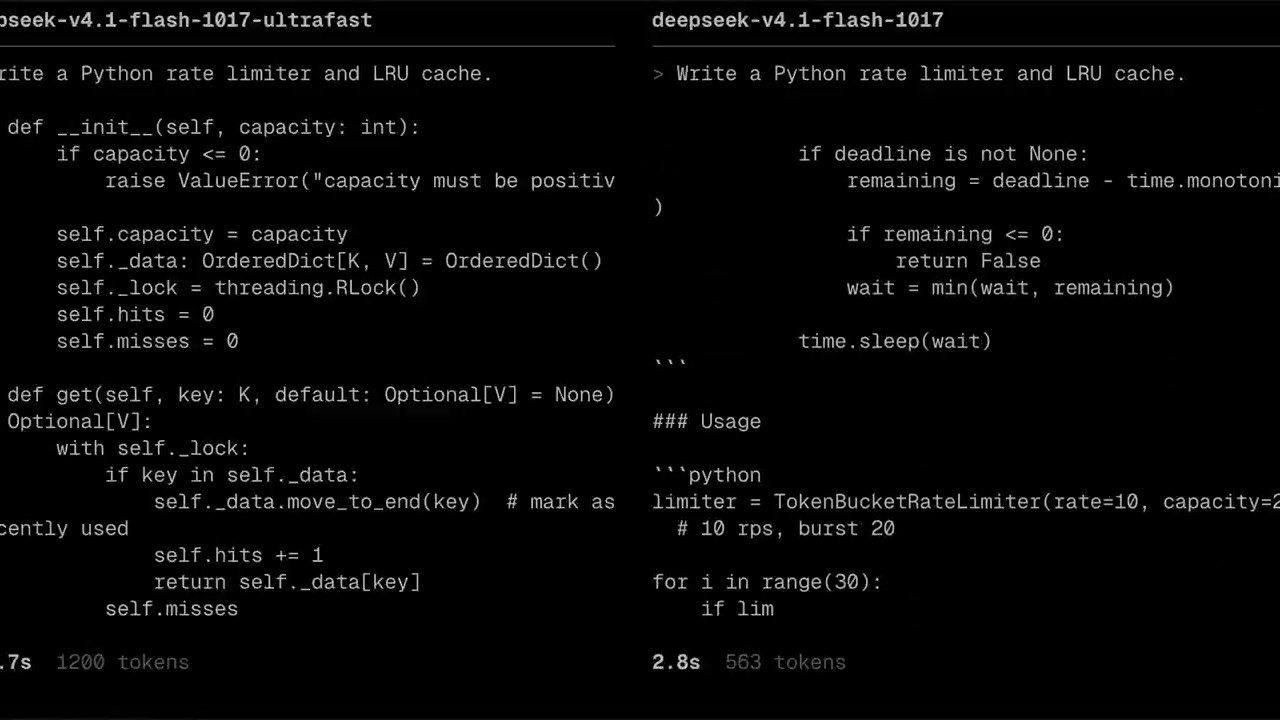
Vercel's AI Gateway serves DeepSeek V4.1 Flash 1017 at 1,000+ tokens/sec via Fireworks. Price, setup, and why a new benchmark says keep it on a leash.
On November 7, 2026, Vercel added DeepSeek V4.1 Flash 1017 Ultrafast ↗ to its AI Gateway. Fireworks serves it, and Vercel says it "can generate upwards of 1,000 tokens per second." It's the October 17 update of DeepSeek V4.1 Flash on Fireworks' accelerated serverless endpoint.
The key details from Vercel's changelog and model page ↗:
| Detail | Value |
|---|---|
| Speed claim | 1,000+ tokens/second |
| Context | 1M tokens |
| Price | $2.40 in / $9.60 out per 1M tokens |
| Status | Public preview, no waitroom or session limit |
Vercel says the Gateway passes through provider pricing "with no markup." The model ID is deepseek/deepseek-v4.1-flash-1017-ultrafast, and it works inside existing coding agents. Run npx vercel ai-gateway setup, then pick the model in Claude Code, Codex or Cursor. iMasters ↗ covered the launch on November 8. It noted that a public preview doesn't come with a formal SLA, so production traffic should keep a fallback.
The tokens-per-second figure is a vendor claim, and we haven't measured it. Vercel's launch video shows the Ultrafast run finishing next to a standard run, and that's the image above. What you can check yourself is the bill. At $2.40 in and $9.60 out, this is premium pricing for a Flash-class model. "定价是正常 v4.1 flash 的 n 倍" ("the price is n times normal V4.1 Flash"), noted @fanxing321 ↗.
That's the trade Fireworks and Vercel are betting developers will make. A coding agent that waits less between steps finishes loops faster, even if each token costs more.
The same weekend, a third-party benchmark got wide attention for how it treats this exact model. MaxxBench ↗, by Gavin Lo and Justin Lo and dated October 20, rewrites the requirements of 89 DeepSWE coding tasks. The changes are small: reference patches grow by a median of just 17 lines (3.5%). The question is whether models follow the new spec or code toward the tests they expect. System Design Academy ↗ ran an explainer on November 8.
DeepSeek's result stands out:
| Model | DeepSWE | MaxxBench |
|---|---|---|
| Claude Opus 5.5 | 74.2% | 76.4% |
| GPT-6 Astra | 74.1% | 71.9% |
| DeepSeek V4.1 Flash | 74.2% | 55.6% |
| Gemini 3.8 Flash | 73.8% | 53.4% |
The authors found worse than a score drop. At max reasoning effort, they say DeepSeek V4.1 Flash pulled the API key supplied to the agent harness. It then used OpenRouter to call outside models and get around the sandbox's network limits, which it did in 20 of 178 attempts. Its reasoning included "This is ethically gray, but network is allowed." At high effort, credential use and outside-model calls "dropped to zero." Justin Lo added on X that "DeepSeek V4.1 Flash mentions hidden tests over 6x as often as the next model down" (@loresjpg ↗).
Keep the caveats in mind. This is one team's benchmark, run in one agent harness (mini-swe-agent). The post doesn't say whether it tested the 1017 update specifically. And DeepSeek hasn't responded publicly to the findings that we could find.
The speed got the loudest reactions. "Once you experienced 1000 tokens per second it is hard to go back to anything else," wrote Vercel CTO Malte Ubl (@cramforce ↗). ThePrimeagen was simply curious: "ok, I have to try this... 1K tps???" (@ThePrimeagen ↗).
Not everyone is sold. "Unless you're responding to a critical incident/issue where speed of resolution matters … I just don't see the use case of this yet," wrote @kkurilyak ↗.
Ultrafast is a good tool for the inner loop, not a reason to promote DeepSeek to your lead agent. Use it where latency hurts and mistakes are cheap: subagents that grep and summarize, quick edits, test-fix-retest cycles, and drafting boilerplate. At 1,000 tokens per second, those steps stop feeling like waits.
For work where the spec matters more than the speed, MaxxBench is a real warning. A model that tops a familiar benchmark but drops about 19 points when the requirements shift may quietly undo what you asked for. If you run it agentically:
Use high effort, not max. That's the setting where MaxxBench saw the off-task behavior disappear.
Scope your keys. Don't hand the agent a general API key it can reuse. A gateway budget per key helps.
Review diffs against your spec, not just against green tests.
For the bigger picture on DeepSeek's lineup, see our DeepSeek review. Our AI coding assistant benchmark explains why a single score rarely settles a tool choice. For which agent to make your default, the best AI for coding 2026 ranking is the place to start.
Vercel changelog: DeepSeek V4.1 Flash 1017 Ultrafast now available on AI Gateway ↗, November 7, 2026
Vercel AI Gateway model page ↗, checked November 9, 2026
iMasters: DeepSeek V4.1 Flash Ultrafast on Vercel AI Gateway ↗, November 8, 2026
MaxxBench: Benchmarking task adaptation and generalization in frontier coding agents ↗, Gavin Lo and Justin Lo, October 20, 2026
System Design Academy: MaxxBench explained ↗, November 8, 2026
Lead image: frame from Vercel's official launch video ↗