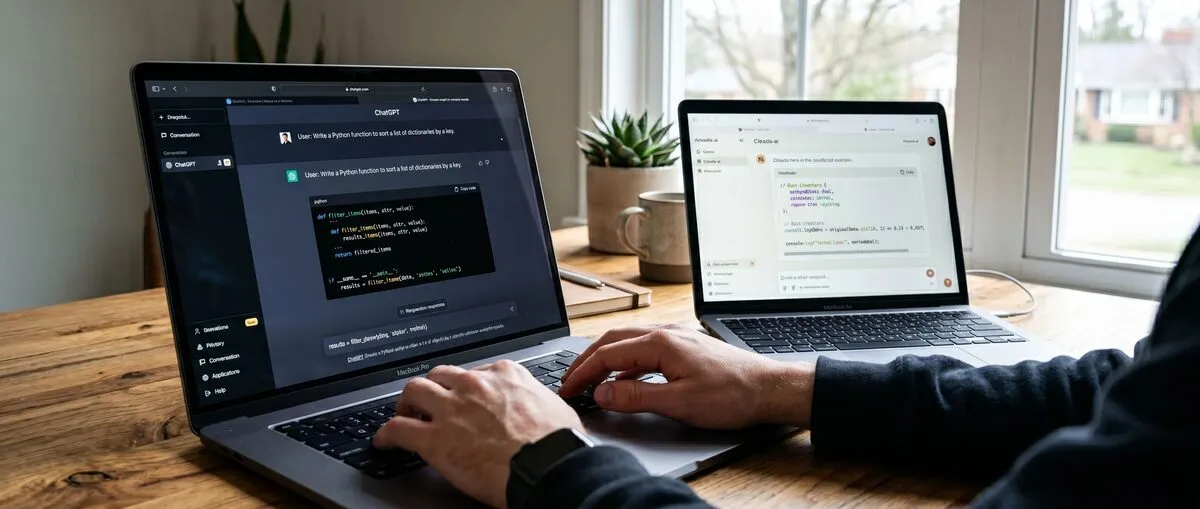
Codex and Claude Code are two of the best-known terminal-based AI coding agents in 2026. The logs behind this post were collected with OpenAI's Codex CLI on GPT-5.5 and Anthropic's Claude Code on Claude Opus 4.8 and Sonnet 4.6. We run both on every production repository we maintain — Claude Code as the primary coding agent, Codex as an automated reviewer that checks every change before it ships. That workflow has produced 1,368 logged Codex reviews of Claude Code's output on live codebases, each finding gradeable against the actual source.
This comparison uses that data, plus our two-round blind benchmark on a 200,000-line production SaaS, instead of marketing claims or synthetic leaderboards.
What is the difference between Codex and Claude Code?
Codex is OpenAI's coding agent (GPT-5.5 in our logs), available as a CLI and inside ChatGPT plans. Claude Code is Anthropic's terminal agent (Claude Opus 4.8 or Sonnet 4.6 in our logs), with hooks, subagents, and MCP tool integrations. Both edit real repositories autonomously; they differ in strengths, not category.
Codex ships as an open-source CLI ↗ that reads, edits, and executes code in a sandboxed workspace. As of September 2026 it is included in ChatGPT plans ↗ from Free (limited use) and Go ($8 per month) up to Plus ($20 per month) and Pro (from $100 per month), with API metering available for automation.
Claude Code ships as a CLI, desktop app, and IDE extension. Through the API it bills Opus 4.8 at $5 input / $25 output per million tokens or Sonnet 4.6 at $3 / $15 ↗, and as of September 2026 subscription access ↗ starts at $20 per month (Pro), with Max from $100 per month. Its strengths are workflow infrastructure: lifecycle hooks, custom subagents, skills, and MCP servers that connect external tools directly into the agent loop. Codex now documents hooks ↗, subagents, and MCP support too, so these features are no longer exclusive to Claude Code.
Which is better at finding real bugs?
In our June 2026 blind benchmark on a 200,000-line production codebase, GPT-5.5 (Codex CLI) tied for first place of seven assistants, scoring 10/10 on a blind debugging round and finding a mobile rendering defect no other assistant caught — because it was the only assistant that actually ran the application.
The benchmark locked ground truth before any assistant saw a prompt: a real escalation bug that had lived in version history for three months. Codex traced the defect from the database schema into the onboarding code, proposed two correct fixes with a regression test, and stayed read-only. The full method and per-assistant results are in our AI coding assistant benchmark.
Claude Code was not scored in that panel for a structural reason: it was the orchestrating agent running the test. Its bug-finding record shows up in the second dataset instead — 1,368 production reviews where Codex graded its work, and the reverse signal of how often Codex found something Claude Code missed.
What happens when Codex reviews Claude Code's work?
Across 1,368 logged reviews of Claude Code's changes on production repositories, Codex blocked 602 turns for re-work. Of the findings we manually verified against the source, 164 were real defects and 5 were false alarms — 97% precision, the highest of seven reviewer models we track.
| Reviewer model | Reviews | Verified real catches | False alarms | Precision |
|---|
| Codex (GPT-5.5) | 1,368 | 164 | 5 | 97% |
| Qwen | 1,122 | 24 | 5 | 83% |
| Grok | 1,086 | 15 | 4 | 79% |
| MiMo | 2,664 | 58 | 22 | 73% |
| GLM | 2,886 | 59 | 24 | 71% |
| MiniMax | 568 | 14 | 13 | 52% |
| Kimi | 1,654 | 24 | 26 | 48% |
Two numbers in that table matter most. Codex caught 491 issues that no other reviewer model flagged on the same diff — it finds problems the rest of the field misses, not just the obvious ones. And its 5 false alarms across 169 graded findings mean a Codex block is almost always worth acting on, which is the property that makes an automated review gate usable at all.
The same data reads in Claude Code's favor from the other side: roughly 56% of its turns passed a 97%-precision reviewer with nothing to flag, on real production work — schema migrations, deploy scripts, UI refactors — not toy tasks.
How much do Codex and Claude Code cost in 2026?
Codex is included in ChatGPT Plus at $20 per month, and in limited form on the Free and Go plans, making it the cheaper entry point. Claude Code on Opus 4.8 costs $5 input / $25 output per million tokens through the API, with subscriptions from $20 (Pro) and $100 (Max) per month, as of September 2026. Heavy agentic sessions push active developers into hundreds of dollars monthly on either stack.
| Codex | Claude Code |
|---|
| Model (in our logs) | GPT-5.5 | Opus 4.8 / Sonnet 4.6 |
| Entry subscription | $20/mo (ChatGPT Plus) | $20/mo (Pro) |
| Higher tier | From $100/mo (ChatGPT Pro) | From $100/mo (Max) |
| API pricing | Metered via OpenAI API | $5/$25 per M tokens (Opus), $3/$15 (Sonnet) |
| Open-source CLI | Yes | No |
| Hooks / subagents / MCP | Supported | Supported |
Plans and prices as of September 2026.
Agentic tools re-read files, expand context, and retry steps, so token consumption scales faster than the visible work. If cost is the deciding factor, open-weight models like Kimi K2.6 ($0.95/$4.00 per million tokens on Moonshot's API as of September 2026) matched the leaders on the debugging round of our benchmark — the full breakdown is in our guide to cheaper Claude Code alternatives.
Should you choose Codex or Claude Code?
Choose Claude Code as the primary agent for long, multi-step work on large codebases — its hooks, subagents, and MCP integrations make it the stronger driver. Choose Codex where verification matters — it executes code, commits to one diagnosis, and posts the highest review precision we have measured. The strongest setup uses both.
| Use case | Pick | Why |
|---|
| Multi-hour agentic sessions, large repos | Claude Code | Workflow infrastructure: hooks, subagents, MCP, skills |
| Code review and pre-merge gating | Codex | 97% precision, 491 unique catches in our logs |
| Blind debugging a live defect | Either | Both top-tier; Codex proved it in our blind round |
| Verifying behavior, not just reading code | Codex | Only benchmark assistant that ran the application |
| Budget-constrained daily driver | Codex | Included in ChatGPT Plus at $20/mo |
Our production answer since early 2026 is the pairing: Claude Code writes, Codex reviews every turn automatically, and a block means re-work before anything ships. The two models fail differently — the writer's blind spots are rarely the reviewer's — which is exactly what you want from a review gate. For the broader tool landscape, see our ranked guide to the best AI coding tools.
Frequently Asked Questions
Is Codex better than Claude Code for coding?
Codex and Claude Code are top-tier at different jobs. In our production logs, Codex is the stronger reviewer — 97% precision across 1,368 reviews — while Claude Code is the stronger long-session driver thanks to hooks, subagents, and MCP integrations. Teams get the best results running both.
Can Codex and Claude Code work together?
Yes. We run Claude Code as the primary coding agent and Codex as an automated stop-gate reviewer on every git project. Codex reviews each completed turn and blocks the session when it finds a real defect, which it did 602 times across 1,368 reviews in our logs.
Which is cheaper, Codex or Claude Code?
Codex is cheaper at entry: as of September 2026 limited Codex use is included in ChatGPT Free and Go, and Plus costs $20 per month. Claude Code is not included in the free Claude plan; it needs Claude Pro at $20 per month or API billing, where Opus 4.8 costs $5 input / $25 output per million tokens and Sonnet 4.6 costs $3/$15.
How accurate is Codex at finding bugs?
Codex posted 97% precision in our logs: of 169 manually verified findings from its reviews of production code, 164 were real defects and 5 were false alarms. It also caught 491 issues no other reviewer model flagged, and scored 10/10 on our blind debugging benchmark.
What models do Codex and Claude Code run in 2026?
Our logs used GPT-5.5 in Codex and Claude Opus 4.8 or Claude Sonnet 4.6 in Claude Code, selectable per session. As of September 2026, OpenAI lists GPT-6 Sol and GPT-6 Luna on its Codex plans and retires GPT-5.5 from Codex on October 14, 2026, while Anthropic's API lineup now includes Claude Opus 5.5 and Sonnet 5. Both vendors rotate models under the same product names, so agent behavior shifts over time even when the tool version does not change.
Sources