What OpenRouter shipped
On November 6, 2026, OpenRouter published Introducing the New Auto and Auto Code Routers ↗ and announced it on X ↗. Two things changed:
Auto Router (openrouter/auto) was rebuilt from scratch. It's the same slug and the same settings, on a new engine.
Auto Code (openrouter/auto-code) is new. It's a router tuned for coding agents and harnesses.
Apply Coding ↗ and other developer outlets picked it up on November 7. Auto Router is nearly three years old, and OpenRouter says it handles more than 2.5 trillion tokens a month from over 100,000 people. A change to how it picks models therefore reaches a lot of production traffic at once, without anyone changing a line of code.
How the new router decides
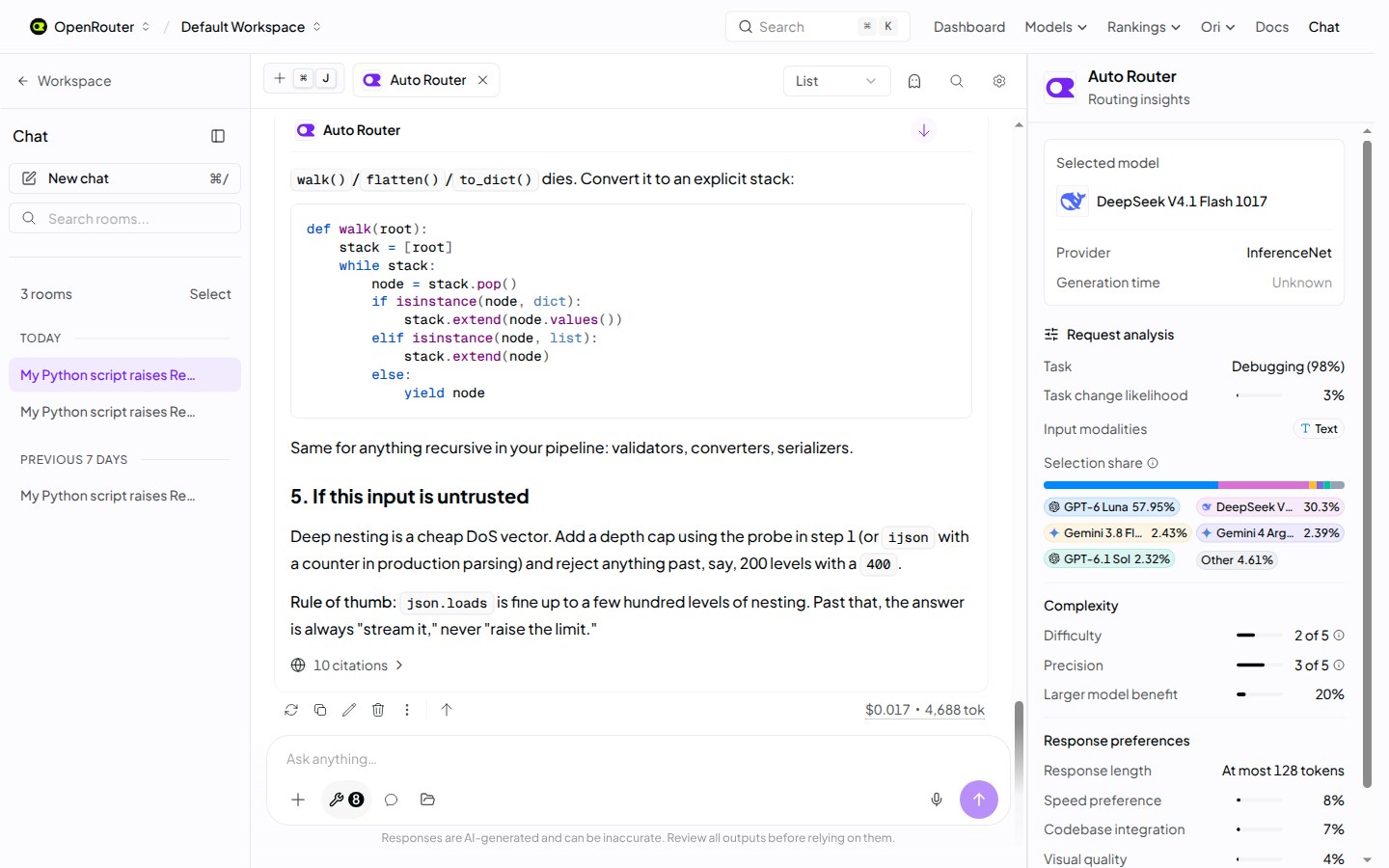
The old router leaned on a few coarse signals, such as task type. Per OpenRouter's post, the new one works like this:
Your rules set the pool first. Guardrails, zero data retention, provider restrictions, allowed or excluded models and BYOK keys decide which models are even eligible.
A fast decision model scores each request on 11 factors. These include task type, whether the task just changed, difficulty, whether speed matters, whether it needs vision or codebase knowledge, and whether a bigger model or more thinking would help.
A routing policy picks both the model and the reasoning effort, using live prices, cache status, provider health and benchmark results.
Results carry over to the next turn. Repeated errors or tests failing after an edit raise the odds of switching models.
Two details matter most for agent builders. First, the router is reluctant to switch models, because a switch throws away the prompt cache. In beta it stayed on the same model for "nearly nine of every ten agent turns." Second, OpenRouter reports that against the old router, invalid tool calls were 4× lower and agent responses were cut off half as often.
The claims, in OpenRouter's numbers
| Claim | OpenRouter's figure |
|---|
| New vs old Auto Router | Up to 4× better, depending on benchmark |
| Routing step latency (p90) | 0.65s vs 1.96s |
| Auto Code vs Claude Opus 5.5 | Similar scores, 74% lower cost per task |
| Router fee | None; you pay the chosen model's price |
These are OpenRouter's own benchmarks. It publishes them on a model-routing benchmarks page and says it reruns them as new models arrive. The Opus 5.5 comparison covers five benchmarks, not your codebase.
The catch: default Auto now costs more
This is the part to read before your next invoice. OpenRouter says the old router had "drift[ed] lower on cost per task" as cheap models got good, so it leaned toward the cheapest models and left out many strong ones. With this release, OpenRouter deliberately moved default pricing back "closer to where Auto was a few months ago." If you call openrouter/auto today, expect a pricier model mix than last week. To get the old behavior back, set cost_tier to low.
OpenRouter is also unusually candid about routers in general: "no router on the market beats the single best frontier model at every point on the cost and quality curve." Its own advice: if you know which model works best for your workload, keep using it.
What people are saying
Developers zeroed in on the pricing change and the switching logic, not the headline number:
"the new default is faster and performs better on benchmarks, but costs more per task than the old version"
— @Haleeeemahh ↗
"The detail I find most interesting isn't the 'in line with Claude Opus 5.5 at 74% lower cost per task' claim. It's the switching logic," wrote @arcbang_xyz ↗. The post added that in a coding harness, "hopping models every turn burns cache and context; getting stuck on the wrong model burns the whole task." Alex of RouteAPI put the caveat bluntly: "A router earns its keep on your workload, not a leaderboard" (@AlexRouteAPI ↗). OpenRouter co-founder Alex Atallah singled out cache awareness as one of the best parts of the launch in a post OpenRouter reposted ↗.
Our take: who should switch
Auto Code is worth a real trial if you pay Opus-class prices for agent work that's mostly routine. Most coding-agent turns are reads, small edits and test runs that don't need a frontier model. A router that escalates only when tests fail is the right design, and the cache-aware switching shows OpenRouter understands how agents actually spend money.
Try it if:
You run Claude Code-style harnesses through OpenRouter and your bill is dominated by Opus 5.5 tokens. Point one project at openrouter/auto-code for a week and compare cost per merged PR, not cost per token.
You don't want to track model releases. New models join the candidate pool the day they're listed.
Stay pinned if:
You already know your best model. OpenRouter says the same.
You need reproducible behavior for evals or regulated work. A router that can change models between runs makes debugging harder. Check the response's model field on every call.
And if you use plain openrouter/auto in production, check your cost dashboards this week and set cost_tier=low if the new mix costs more than it's worth.
For cheaper fixed alternatives to Opus, see our cheaper Claude Code alternatives and the wider best AI for coding 2026 ranking. If you're choosing between agent harnesses, read Codex vs Claude Code.
Sources