AI coding tools have evolved from simple autocomplete to autonomous programming agents. Over 70% of developers use AI coding assistance daily in 2026. Cursor leads with 17/20 code quality scores, GitHub Copilot dominates market share at $10/month, and Windsurf offers enterprise-grade features completely free.
What has changed in the 2026 AI coding landscape?
AI coding tools evolved from line suggestions to autonomous agents that understand entire codebases, write complete functions, and debug complex issues independently. Cursor achieves 17/20 professional-grade scores while new tools like Windsurf provide advanced features free.
Modern AI coding tools analyze complete codebases, maintain context across multiple files, and generate production-ready code with minimal human intervention. Cursor leads this evolution with superior multi-file understanding and can refactor entire modules while maintaining consistency across project architecture. GitHub Copilot evolved beyond line-by-line suggestions to offer workspace-level capabilities and repo-wide task automation.
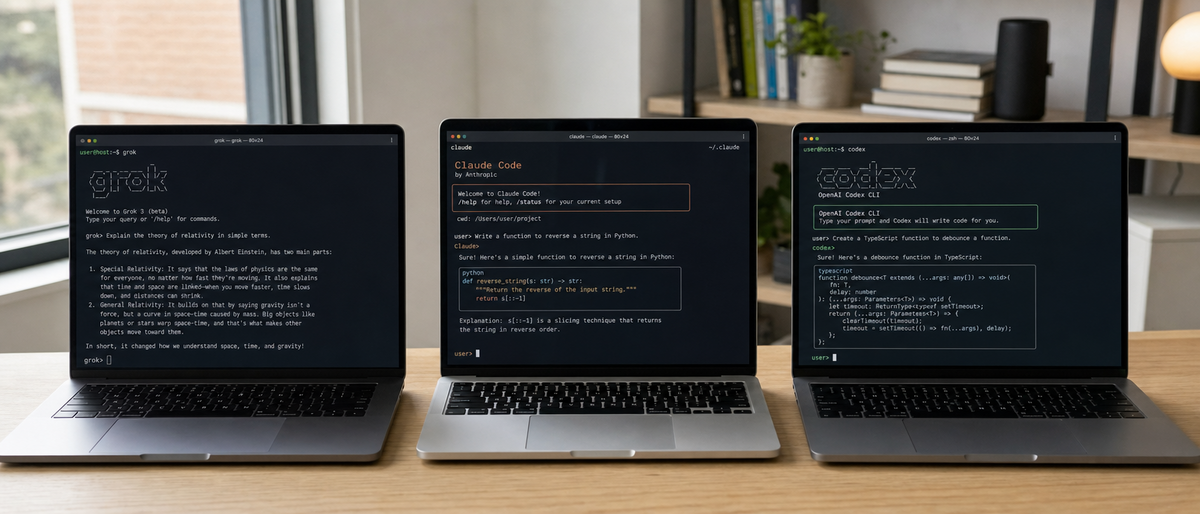
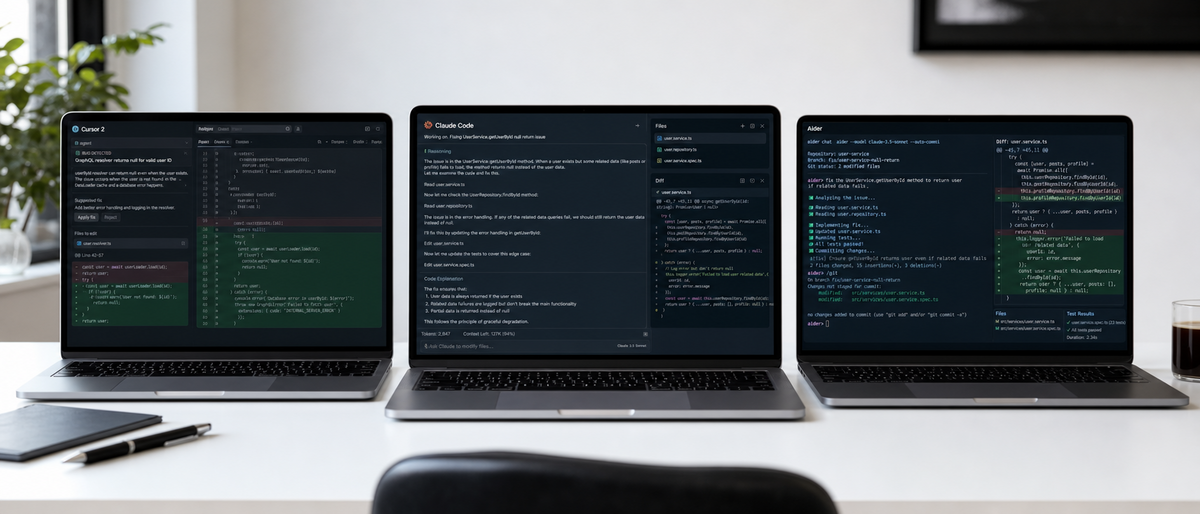
Autonomous coding agents represent the newest frontier. Claude Code and Devin AI execute complete development tasks independently, from writing unit tests to implementing entire features. These agents work through terminal interfaces, making decisions and writing code with minimal human oversight.
GitHub Copilot remains the industry standard with the largest user base and most extensive ecosystem integration. Its $10/month price point and proven stability make it the safe choice for most development teams. Cursor emerged as the premium alternative, offering deeper codebase awareness at $20/month. Early adopters report significantly better code suggestions for complex refactoring tasks. Windsurf disrupts the pricing model by offering robust AI features completely free.
Browser-based platforms like PlayCode represent another emerging category. With 15+ AI model choices and zero installation requirements, these tools appeal to non-developers and teams seeking instant access to AI coding capabilities.
Enterprise adoption focuses on security, compliance, and integration capabilities. Tabnine leads this segment with local execution models and air-gapped deployment options that keep sensitive code within company infrastructure. Amazon Q Developer targets AWS-native teams with deep cloud service integration.
Individual developers prioritize cost-effectiveness and ease of use. Free tools like Windsurf and PlayCode gained significant traction, while premium options like Cursor appeal to professionals seeking maximum AI capability.
The top AI coding tools include Cursor ($20/month) for codebase awareness, GitHub Copilot ($10/month) for ecosystem integration, Windsurf (free) for budget users, PlayCode ($9.99/month) for browser-based development, and Claude Code ($20/month) for autonomous programming.
Cursor represents the pinnacle of AI-first editor design. Built from the ground up with AI integration, it offers unmatched codebase awareness and multi-file understanding. The tool excels at complex refactoring tasks, earning consistent praise for producing professional-grade code across multiple programming languages.
Windsurf provides surprising capability for a completely free tool. It offers many of Cursor's advanced features without cost, making it an excellent entry point for developers exploring AI coding assistance. The tool handles most common coding tasks effectively.
Zed focuses on performance optimization, delivering a Rust-based editor that runs at 120 fps. At $10/month pricing, its speed-focused design appeals to developers who prioritize responsiveness alongside AI capabilities.
GitHub Copilot remains the gold standard for traditional editor integration. Available across VS Code, JetBrains IDEs, and other popular editors, it provides consistent AI assistance without forcing workflow changes. The recent addition of agent capabilities expands its functionality to workspace-level tasks.
Tabnine differentiates itself through privacy-focused features and local execution models. Starting at $12/month, it offers enterprise-grade security with air-gapped deployment options. This makes it ideal for companies with strict data policies or sensitive codebases that cannot use cloud-based AI services.
PlayCode leads the browser-based category with 15+ AI model choices and production-ready code generation capabilities. Its free tier provides substantial functionality, while the $9.99/month premium plan unlocks unlimited AI assistance. The platform requires zero installation and works across any device with a web browser.
Replit combines cloud IDE functionality with autonomous agent capabilities. At $25/month, it targets collaborative teams needing shared development environments. The platform's strength lies in its seamless integration of coding, hosting, and deployment within a single interface.
Bolt.new specializes in rapid web development prototyping. It excels at generating complete web applications from natural language descriptions, making it valuable for quick proof-of-concept development and client demonstrations.
Claude Code operates as a terminal-based autonomous agent capable of executing complete coding tasks independently. At $20/month, it represents the cutting edge of AI coding automation. The tool can implement entire features, write comprehensive test suites, and handle complex debugging scenarios with minimal human intervention.
Cline provides an open-source alternative to commercial autonomous agents. As a VS Code extension, it brings agent-like capabilities to familiar development environments.
Devin AI markets itself as the first fully autonomous AI software engineer. Currently in limited access, it represents the most ambitious attempt at fully automated software development.
Amazon Q Developer (formerly CodeWhisperer) targets AWS-native development teams. The tool offers deep integration with Lambda, DynamoDB, CloudFormation, and other AWS services. Individual developers can access it free, while professional teams pay $19/month for advanced features and priority support.
JetBrains AI Assistant provides native integration across the JetBrains IDE ecosystem. Starting at $10/month, it offers context-aware suggestions optimized for IntelliJ IDEA, PyCharm, and other JetBrains tools.
| Tool | Category | Price | Best For | Key Strength |
|---|
| Cursor | AI-First Editor | Free/$20/mo | Complex projects | 17/20 codebase awareness score |
| GitHub Copilot | Extension | $10/mo | Industry standard | Largest ecosystem, proven stability |
| Windsurf | AI-First Editor | Free | Budget-conscious | Full AI features at no cost |
| PlayCode | Browser-Based | Free/$9.99/mo | No installation | 15+ AI models, production-ready code |
| Claude Code | Autonomous Agent | $20/mo | Independent tasks | Terminal-based full autonomy |
| Amazon Q | Enterprise | Free/$19/mo | AWS projects | Deep cloud service integration |
| Tabnine | Extension | $12/mo+ | Privacy/Security | Local execution, air-gapped deployment |
| Zed | AI-First Editor | $10/mo | Performance | Ultra-fast 120fps Rust-based editor |
| Replit | Browser-Based | Free/$25/mo | Collaboration | Cloud IDE with agent capabilities |
| JetBrains AI | Enterprise | $10/mo+ | JetBrains users | Native IDE integration |
How do Cursor, GitHub Copilot, and Windsurf compare?
Cursor achieves 17/20 code quality scores with superior codebase awareness at $20/month. GitHub Copilot scores 14/20 with proven reliability at $10/month. Windsurf scores 12/20 but offers comprehensive AI features completely free.
Cursor achieves the highest code quality scores in professional testing, earning 17 out of 20 for overall coding intelligence. Its superior codebase awareness allows it to generate more contextually appropriate suggestions, particularly for complex refactoring tasks involving multiple files. The tool consistently produces production-ready code with minimal editing required.
GitHub Copilot scores well for reliability and consistency, earning approximately 14 out of 20 in the same benchmarks. Its suggestions feel natural and integrate smoothly into existing coding workflows across different programming languages and frameworks.
Windsurf performs surprisingly well for a free tool, achieving roughly 12 out of 20 in professional scoring. It handles most common coding tasks effectively and represents exceptional value for developers seeking AI assistance without financial commitment.
Cursor excels in understanding relationships between files and maintaining architectural consistency across large codebases. It can suggest changes that properly handle dependencies, imports, and cross-file references. This capability proves invaluable for refactoring legacy code or implementing features that span multiple modules.
GitHub Copilot provides moderate codebase awareness, primarily focusing on the current file context with limited understanding of broader project structure. Recent agent mode updates have improved this capability.
Windsurf offers basic codebase awareness sufficient for most individual development tasks. It handles file imports and basic dependency management adequately for smaller projects.
For individual developers, Windsurf provides the best value proposition with its completely free offering. Teams requiring advanced capabilities should consider Cursor's $20/month premium for complex projects or GitHub Copilot's $10/month for reliable, ecosystem-integrated assistance.
Enterprise teams often find GitHub Copilot's $39/month enterprise tier worthwhile for its proven stability and extensive integration options. Cursor's premium tier appeals to teams prioritizing AI capability over cost, particularly for projects involving significant refactoring or architectural changes.
GitHub Copilot provides the most seamless VS Code integration at $10/month with proven stability. Windsurf offers an excellent free alternative with VS Code-like interface design. Cursor requires editor migration but provides superior AI capabilities at $20/month.
GitHub Copilot works natively within the VS Code environment without requiring workflow changes. It provides consistent AI assistance across the VS Code ecosystem with extensive extension support and marketplace integration.
Windsurf offers an excellent free alternative with similar VS Code-like interface design. Users can access advanced AI features without cost while maintaining familiar development workflows.
Cursor represents the premium option for VS Code users willing to switch editors. While it requires abandoning VS Code, it provides significantly superior AI capabilities and codebase awareness. The transition cost proves worthwhile for developers working on complex, multi-file projects requiring deep contextual understanding.
Tabnine serves VS Code users prioritizing privacy and security. Its local execution model ensures code never leaves your development environment, making it suitable for sensitive projects or enterprise environments with strict data policies.
JetBrains AI Assistant provides native integration for IntelliJ IDEA and PyCharm at $10/month. GitHub Copilot supports JetBrains IDEs with cross-platform consistency. Cursor requires migrating away from JetBrains tools but offers advanced AI capabilities.
JetBrains AI Assistant provides the most natural integration for IntelliJ IDEA, PyCharm, and other JetBrains tools. At $10/month, it offers context-aware suggestions optimized specifically for JetBrains workflows and features.
GitHub Copilot also supports JetBrains IDEs effectively, providing cross-platform consistency for teams using multiple development environments. Its broader ecosystem integration benefits teams working across different tools and platforms.
Cursor works with JetBrains-style workflows but requires migrating away from native JetBrains tools. For teams heavily invested in JetBrains ecosystems, this switching cost outweighs Cursor's advanced AI capabilities.
Amazon Q Developer dominates cloud-native development with deep AWS service integration. Individual developers access it free, while professional teams pay $19/month. It understands Lambda functions, DynamoDB schemas, and CloudFormation templates.
Amazon Q Developer offers deep AWS service integration and understands Lambda functions, DynamoDB schemas, CloudFormation templates, and other AWS-specific constructs. Individual developers can access it free, while professional teams pay $19/month for advanced features.
GitHub Copilot provides general cloud development assistance but lacks the specialized AWS knowledge of Amazon Q. It works well for generic cloud patterns but requires more manual context for AWS-specific implementations.
Cursor and other general-purpose tools can handle cloud development effectively but don't offer the specialized AWS integration that makes Amazon Q particularly valuable for cloud-native teams. For comprehensive coverage of our testing methodology and performance analysis, see our detailed Claude Code review which covers similar benchmarking approaches.
Tabnine leads enterprise security with local execution models, air-gapped deployment options, and comprehensive compliance certifications starting at $12/month. JetBrains AI Assistant offers enterprise-grade security within the JetBrains ecosystem with on-premises deployment options.
Tabnine ensures sensitive code never leaves your infrastructure while still providing advanced AI coding assistance. It offers local execution models, air-gapped deployment options, and comprehensive compliance certifications starting at $12/month.
JetBrains AI Assistant offers enterprise-grade security within the JetBrains ecosystem, with options for on-premises deployment and data residency controls. It balances security requirements with seamless IDE integration.
Amazon Q Developer provides enterprise security features for AWS-native environments, with integration into existing AWS security and compliance frameworks. This makes it suitable for organizations already committed to AWS infrastructure.
How do autonomous AI agents differ from traditional code assistants?
Autonomous AI agents like Claude Code execute complete development tasks independently through terminal interfaces, making architectural decisions without human guidance. Traditional assistants like GitHub Copilot enhance human workflows through intelligent suggestions and contextual assistance.
Autonomous AI agents can execute complete development tasks independently, from initial requirements to finished implementation. Tools like Claude Code and Devin AI operate through terminal interfaces, making decisions about architecture, implementation approach, and testing strategies without constant human guidance.
These agents can write entire functions, implement complete features, generate comprehensive test suites, and even debug complex issues across multiple files. They represent a fundamental shift from suggestion-based assistance to independent task execution.
Traditional code assistants like GitHub Copilot and Cursor focus on enhancing human coding workflows through intelligent suggestions, autocompletion, and contextual assistance. They excel at accelerating existing development processes rather than replacing human decision-making entirely.
Use autonomous agents for isolated development tasks, proof-of-concept implementations, or routine coding work that doesn't require complex business logic decisions. They excel at generating boilerplate code, implementing standard patterns, and creating comprehensive test coverage.
Use traditional assistants for daily development workflows, complex business logic implementation, and collaborative coding environments. They provide the right balance of AI enhancement and human control for most professional development scenarios.
Terminal-based agents like Claude Code appeal to developers comfortable with command-line interfaces and automation workflows. They integrate well with existing DevOps processes and can be scripted for repeatable development tasks.
GUI-based solutions like Cursor and GitHub Copilot provide visual feedback and integrate with familiar development environments. They offer lower barriers to adoption and work better for developers preferring graphical interfaces.
Windsurf offers comprehensive AI coding features without cost limitations, including code completion and refactoring suggestions. PlayCode provides 15+ AI model choices with production-ready code generation in browsers. Amazon Q Developer gives individual developers free access with AWS integration.
Windsurf leads the free tier category by offering comprehensive AI coding features without cost limitations. It provides code completion, refactoring suggestions, and basic codebase awareness comparable to many paid alternatives. The tool handles most common development tasks effectively.
PlayCode offers substantial free functionality with 15+ AI model choices and production-ready code generation. The free tier provides enough capability for learning, prototyping, and small project development. The browser-based approach eliminates installation barriers entirely.
Amazon Q Developer provides free access for individual developers, including basic code suggestions and AWS service integration. This makes it particularly valuable for developers working on personal AWS projects or learning cloud development patterns.
What premium AI coding features justify the cost?
Advanced codebase awareness in tools like Cursor ($20/month) provides significantly better understanding of multi-file relationships and architectural patterns. Enterprise integration capabilities including SSO, audit logging, and compliance certifications prove essential for business use cases.
Advanced codebase awareness justifies premium pricing for complex projects. Tools like Cursor ($20/month) and GitHub Copilot ($10/month) provide significantly better understanding of multi-file relationships, architectural patterns, and project-specific context.
Enterprise integration capabilities become essential for professional development teams. Features like SSO integration, audit logging, and compliance certifications available in premium tiers prove necessary for business use cases.
Priority support and reliability guarantees distinguish premium offerings from free alternatives. Professional developers find the improved uptime, faster response times, and dedicated support worth the additional cost for mission-critical projects.
GitHub Copilot Enterprise at $39/month per user provides comprehensive features including advanced security, audit capabilities, and organization-wide policy management. Studies suggest 20-30% productivity improvements, often justifying the cost for development teams.
Tabnine Enterprise starts at $59/month per user but offers local execution and air-gapped deployment options essential for organizations with strict security requirements.
FAQ
Q: Which AI coding tool offers the best code quality?
A: Cursor achieves the highest code quality scores at 17/20 in professional testing, with superior codebase awareness and multi-file understanding capabilities.
Q: What is the most cost-effective AI coding solution?
A: Windsurf provides comprehensive AI coding features completely free, including code completion, refactoring suggestions, and basic codebase awareness.
Q: Which tool works best for enterprise security requirements?
A: Tabnine leads enterprise security with local execution models, air-gapped deployment options, and comprehensive compliance certifications starting at $12/month.
Q: What AI coding tool has the largest user base?
A: GitHub Copilot remains the industry standard with the largest user base and most extensive ecosystem integration at $10/month.
Q: Which autonomous AI agent offers the most advanced capabilities?
A: Claude Code operates as a terminal-based autonomous agent at $20/month, capable of executing complete coding tasks independently with minimal human intervention.
Q: What is the best AI coding tool for AWS development?
A: Amazon Q Developer dominates cloud-native development with deep AWS service integration, offering free access for individual developers and $19/month for professional teams.