AI News · 4 min read
Gemini Notebook 'make me a site' builds interactive sites
On November 16, 2026, Gemini Notebook began turning notebook sources into interactive sites from a make me a site prompt. Web only, users 18 and older.
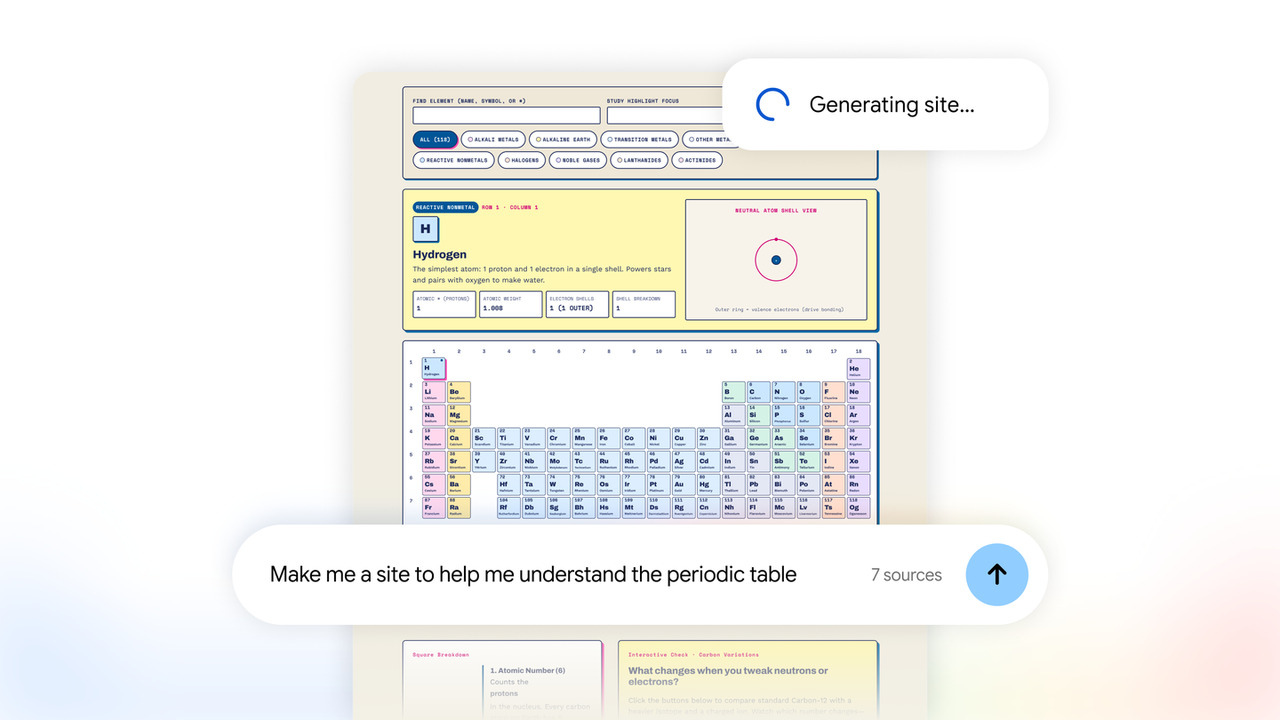
On November 16, 2026, Gemini Notebook began turning notebook sources into interactive sites from a make me a site prompt. Web only, users 18 and older.
On November 16, 2026, Maria Ines Aranguren, a software engineer at Google Labs, published Transform notes, research, and sources into interactive sites with Gemini Notebook ↗. Digital Trends ↗, PPC Land ↗, and Android Authority ↗ covered the rollout. The picture above is the announcement image on Google's post. We have not built a site with this feature.
The way in is a chat prompt. Type "make me a site" in Gemini Notebook, plus a description of what you want for work or study. Google's examples are visual explainers for exams, including an interactive periodic table or a historical timeline; interactive dashboards, including quarterly sales performance; and project management trackers that outline tasks and deadlines.
Once the site is built, select "Open in a new tab" to interact with it, or share it with others. The capability is rolling out globally on the web from November 16 for Gemini Notebook users 18 and older, including Google Workspace subscribers. Google says the mobile app is "coming soon." The post gives no date.
Digital Trends ↗ describes Google's demo. A notebook of chemistry material becomes a site titled "Understanding the Periodic Table," with a clickable table, plain-language sections, and a five-question quiz. A second prompt turns five sales documents into a dashboard with region filters, revenue against quota, and pipeline charts.
Digital Trends sets that beside two older builders. Canvas in the Gemini app, from March 2025, codes web app prototypes. Claude lets users turn artifacts into shareable apps. Gemini Notebook differs because the sites are built from the sources already in the notebook.
PPC Land ↗ identifies Gemini Notebook as the tool known until July as NotebookLM. The trigger is a phrase in the chat, not a Studio tile. In a still from Google's video, PPC Land says the Studio panel shows Audio Overview, Slide Deck, Video Overview, Mind Map, Reports, Flashcards, Quiz, Infographic, and Data Table. None of those tiles is the site builder.
Google's post does not name the model that builds the sites. It does not state a price, a plan limit, or a usage cap. It does not say how a shared link is permissioned, or what a Workspace administrator can restrict. It does not report an accuracy evaluation. This desk is not assigning the feature to a model Google left unnamed.
"Gemini has made building interactive sites 100x easier" — Master Zeks ↗ (@M_zekks)
"half the internal dashboards i've built were just someone's notes with a chart on top, so this one stings a bit" — Magnus ↗ (@mKLAPPEREN_)
"would you send a client a page built this way?" — Arul Pradeep ↗ (@arulpradeepp)
Students, analysts, and project managers who already keep sources in a notebook are the audience. Those are the jobs Google named: an exam explainer, a quarterly sales view, a tracker of tasks and deadlines. If the files are not in the notebook, the prompt has nothing grounded to draw on.
It is worth opening today for a study aid or a one-off internal dashboard. It is not a website builder for a public site. Arul Pradeep's question is the test that matters. A page sent to a client has to survive a check against the source file. One wrong number in a generated chart looks like a finished report. Magnus's description, notes with a chart on top, is both the job this replaces and the failure mode. Read every figure against the source before anyone else opens the link.
The notebook source is the difference from the other builders. Canvas, Claude artifacts, and generic prompt-to-site tools such as Lovable and Bolt start from a blank instruction. Digital Trends' point is that these sites start from files you already stored. That is a better start. It is still a generated page. Google has not documented sharing controls for Workspace data. Until that documentation exists, keep a sales dashboard with the people who already have the notebook.
The web version is the product you can open now. The mobile app has no date. Antigravity's knowledge-work layout is a different Google surface. Gemini memory is the control for saved memory, not this builder. The Gemini 4 Hydrogen price note is a model-price story. Google did not say these sites use that model. Claude's sheets, whiteboards, and connectors are Anthropic's interactive documents. Plan comparisons are in ChatGPT vs Claude vs Gemini. Other builders are in the no-code agent builder review. Work that should stay a literature review, rather than a generated site, is the Elicit review.