What NVIDIA published on November 5, 2026
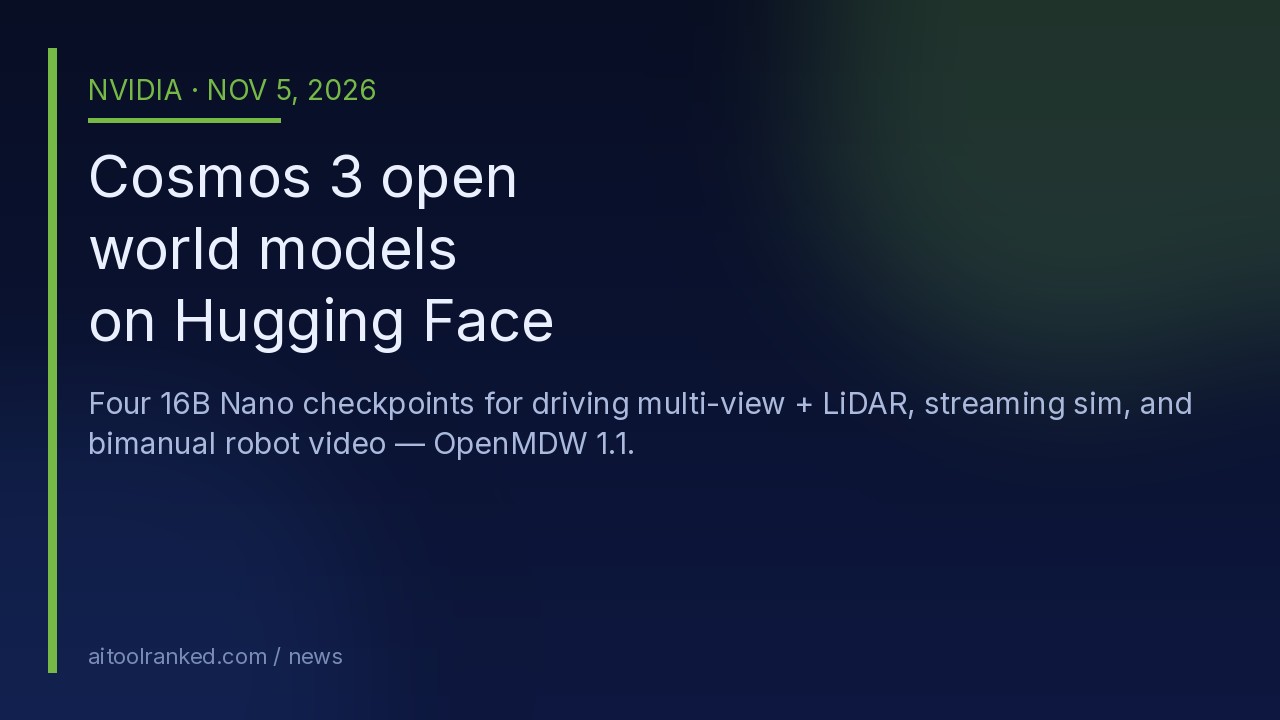
NVIDIA’s Hugging Face team posted New NVIDIA Cosmos 3 Open Models for Interactive World Simulation ↗ on November 5, 2026, with a Cosmos3 collection ↗ of checkpoints.
These are world / simulation models, not chat LLMs. The release adds four open-weight post-trained examples of Cosmos 3 Nano, each with 16B trainable parameters, under OpenMDW 1.1 (NVIDIA states commercial and non-commercial use are permitted under that license’s terms — read the license file before you ship).
The four checkpoints named in the HF blog:
| Checkpoint | Role (per NVIDIA) |
|---|
| Cosmos3-Nano-Transfer-Auto | Offline synthetic driving data: multi-view video (up to 11 cameras, including fisheyes), optional joint RGB–LiDAR, World Scenario Map controls + text for appearance |
| Cosmos3-Nano-Sim-Auto | Causally distilled streaming variant of Transfer-Auto: successive chunks of synchronized camera + LiDAR from history + updated driving controls |
| Cosmos3-Nano-Sim-Transfer | Physics-simulator controls (depth / segmentation / edges / blur) + text → photorealistic RGB for policy loops |
| Cosmos3-Nano-Sim-Bimanual | Action-conditioned video for two-arm robots (YAM and AgiBot embodiments called out); joystick or policy control |
Training recipe NVIDIA documents (attribute to the blog / tech report — not our lab): Stage 0 bidirectional adaptation → Stage 1 teacher forcing → Stage 2 consistency distillation (student generates a chunk in four denoising steps) → Stage 3 self-forcing on the student’s own history. Mixture-of-Transformers backbone connects text and visual networks; after the first image, each latent time step represents four RGB frames.
Runtime note from the post: published vLLM-Omni setup was tested on one GB200; that is not a minimum-memory spec. Requirements listed: Linux, NVIDIA GPU, Docker, NVIDIA Container Toolkit.
Post-training recipes are included so labs can adapt Transfer-Auto to their own sensor rig, then distill to Sim-Auto; Sim-Transfer and Sim-Bimanual have embodiment / environment adaptation paths. NVIDIA’s own caveat: measure where the models support policy learning, understand limits, improve where they fall short — this is not a claim that closed-loop AV or robot policies are “solved.”
What people are saying on X
Concise open-weights summary:
“JUST IN: NVIDIA added four open-weight Cosmos 3 checkpoints for world simulation, all 16B. They cover multi-view driving data (up to 11 cameras plus LiDAR), streaming driving sim, and two-arm robot video.
Commercial use allowed under OpenMDW 1.1.”
— @globalsinews ↗
HF pointer:
“NVIDIA has released Cosmos 3, a family of open models designed for interactive world simulation, now available on Hugging Face.”
— @techwithjoe_io ↗
Spec sheet style recap:
“NVIDIA released four open Cosmos 3 checkpoints for interactive world simulation: multi-view driving data with joint RGB-LiDAR, streaming sim from controls, and action-conditioned robot video. All 16B post-trained from Cosmos 3 Nano under OpenMDW 1.1.”
— @Secretof_forest ↗
Our take: who should care
AV / robotics simulation teams: Transfer-Auto + Sim-Auto are the pair to evaluate first if you need synchronized multi-camera + LiDAR synthetic data and a path to streaming closed-loop rollouts — with the hard requirement that you still own a simulation runtime / WSM renderer for control updates. Sim-Bimanual is the dual-arm manipulation track; Sim-Transfer is for teams that already trust a physics engine and want better RGB from its state.
Open-weights builders outside big labs: this is a different open release than Kimi K3.1 Pro weights or Baidu ERNIE 5.5 Flash Base. Those are LLM/MoE text (or vision-language) stacks. Cosmos 3 is interactive world simulation — budget GPU/Docker time accordingly, and do not paste LLM leaderboard habits onto driving/robot video models.
Vs video-generation products on this desk: Gemini Omni 1.2 Flash is a product video API (15s clips, ads/try-on). Cosmos 3 is research/infra for policy-facing observation generation with controls and sensors. Overlap is “video out”; buyers and eval harnesses are not the same.
Action this week: pull the HF collection, run the published notebook/skill for the checkpoint that matches your domain, and score held-out episodes before any training spend. Read OpenMDW 1.1 end-to-end. Treat GB200 test notes as “known good,” not “required.”
For open-model landscape see best open-source LLMs 2026. For agent stacks see best AI agent frameworks 2026. Adjacent multimodal video: Gemini Omni 1.2 Flash.
AdSense-safe note: we are documenting NVIDIA’s published open Cosmos 3 checkpoints and how to evaluate them for sim/research — not an upsell for any NVIDIA cloud SKU.
Sources