What OpenAI announced on November 4, 2026
OpenAI published OpenAI to acquire Pierre Computer Company, Inc. ↗ on November 4, 2026. Independent confirmations followed from The Verge ↗ and Axios ↗ (GitHub-competition framing).
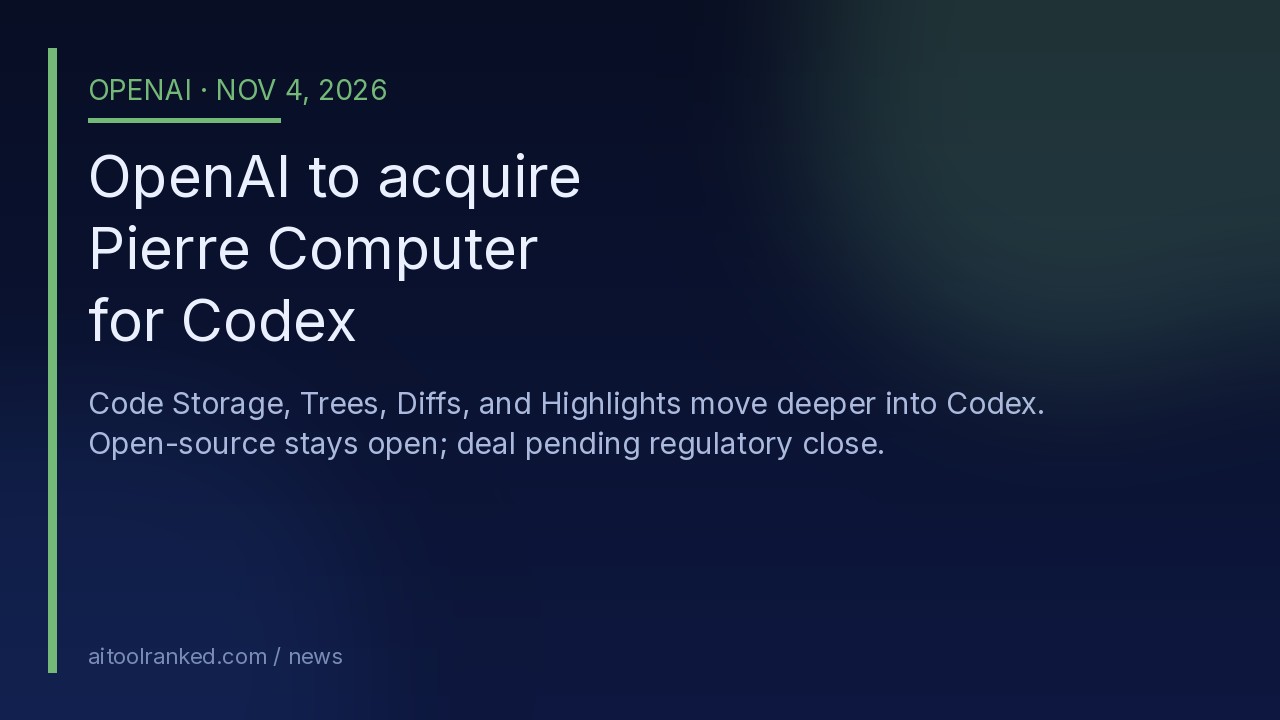
Pierre is the company behind Code Storage and a family of open-source developer tools. OpenAI’s post is explicit that if you have browsed files or reviewed a change in the Codex app, you have already used Pierre’s Trees and Diffs libraries. The stated goal is to expand Codex from “writes code” toward the full path from first branch to shipped software — alongside OpenAI’s own in-house Git scaling work (Pando), mentioned in the same post as context from earlier that week.
Dated / attributed facts (do not invent deal terms — OpenAI did not disclose price):
Target: Pierre Computer Company, Inc. (“Pierre”).
Already inside Codex: Trees (fast project file navigation) and Diffs (change review). OpenAI also calls out Diffs’ Edit mode (fix a line where you spot the problem) and Pierre’s recent Highlights syntax highlighter that updates as a developer types or an agent streams code.
Code Storage: Pierre’s Git-based service for apps to store code and track history. OpenAI says customers can keep using Code Storage after close while features are brought into Codex.
Open source: Pierre’s open-source projects remain open-source; OpenAI says it will continue contributing.
Status: acquisition has not closed. Subject to customary closing conditions, including regulatory approvals. Until close, OpenAI and Pierre “remain separate and independent companies.”
Ambition language (vendor): “set the standard for modern software development” for developers and agents; “connect the code a company ships with the decisions its people make.” Treat that as positioning, not a shipped feature list.
What people are saying on X
Official Newsroom post (~4.6k likes / ~540k impressions at research time):
“Today we’re announcing that OpenAI will acquire @pierrecomputer to accelerate our vision for making Codex a place where teams can build software together with AI, from first idea to the version they ship.
Pierre’s open-source developer tools already power parts of Codex today. Together, we’ll build on that foundation for the agentic era.”
— @OpenAINewsroom ↗
Straight summary with the open-source / regulatory caveats:
“OpenAI has announced plans to acquire Pierre, the company behind several developer tools already used in Codex.
Its Trees and Diffs libraries power file browsing and code review. OpenAI also plans to bring Pierre’s Code Storage functionality into Codex.
Pierre’s open-source projects will remain open-source. The acquisition is pending closing conditions, including regulatory approvals.”
— @WesRoth ↗
Platform read (storage/review, not just generation):
“OpenAI (@OpenAI) has agreed to acquire Pierre Computer Company (@pierrecomputer), the developer tools startup behind the Git-based service Code Storage, as it works to turn its Codex coding agent into a platform for storing, reviewing and shipping software, not only writing it.”
— @financenewsint ↗
Our take: who should care
Codex users and agentic coding teams: this is less “new model” and more source-control / review plumbing. If your bottleneck is reviewing parallel agent branches, navigating huge trees, or keeping a durable Git history next to the agent loop, Pierre’s stack is already the UI layer OpenAI is doubling down on — watch for Code Storage features landing inside Codex after close, not a day-one product rename.
Open-source / self-host consumers of Trees, Diffs, Highlights: OpenAI’s written commitment is that those projects stay open-source. Still treat post-close governance as a watch item — calendar the close date and re-check licenses/contribution policy when it lands. Do not invent a sunset.
Competitive framing: Axios and others cast this as pressure on Microsoft-owned GitHub as agent-generated code volume rises. That is a secondary narrative, not something OpenAI’s post names. For buyers, the practical question is whether Codex becomes a place you store and ship work — vs Cursor’s same-week Build Live Apps bet on prompt → hosted URL, or Claude Code’s cloud/session workflow. Different surfaces: storage/review platform vs deploy-from-IDE vs coding agent.
Action this week: if you already depend on Codex review UX, keep using Trees/Diffs as-is; if you use Code Storage as a customer, read OpenAI’s “continues after close” line and ask your vendor contact for a migration timeline once regulators clear. No need to rip GitHub out on announcement day — the deal is not closed.
For coding assistants see best AI for coding 2026. For review tooling see best AI code review tools 2026. For editor comparisons see GitHub Copilot vs Cursor 2026.
AdSense-safe note: we are documenting OpenAI’s published acquisition announcement and how to evaluate Codex / open-source continuity — not investment advice and not an upsell for any paid OpenAI plan.
Sources