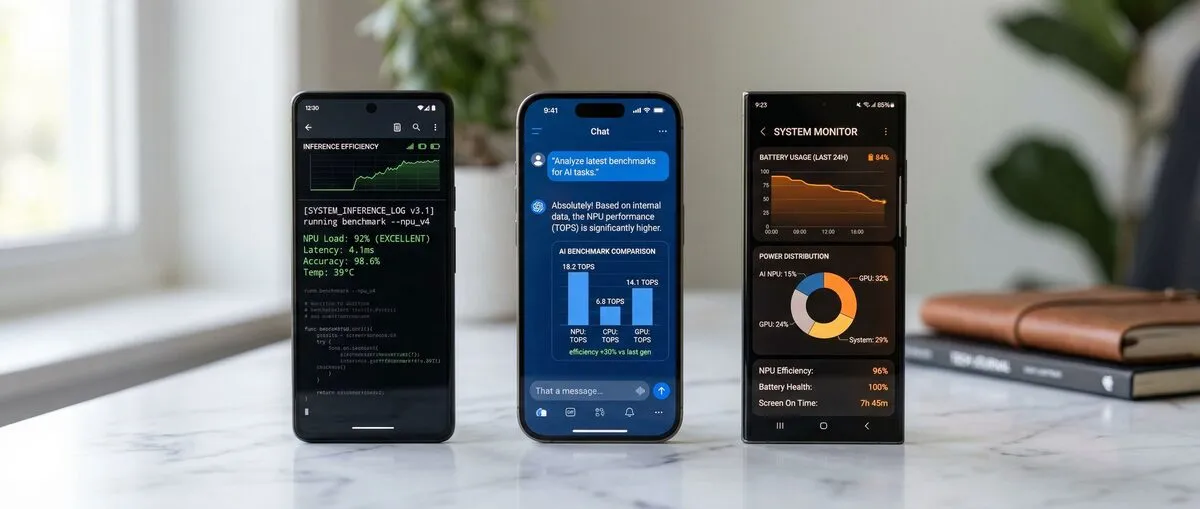
Google released Gemma 4 in April 2026 under the Apache 2.0 license, including two edge models (E2B and E4B) built for phones and other devices, according to Google's announcement ↗. The earlier Gemma 2 9B scored 71.3 on MMLU (5-shot) in the Gemma 2 technical report ↗. Ollama is a free, MIT-licensed tool for local LLM inference with a REST API and an OpenAI-compatible endpoint.
Why Are Developers Adopting On-Device Local LLMs in 2026?
On-device local LLMs offer private AI without cloud dependency, no per-token API costs, and no network round trip. Users keep full data control and can run the same model and settings repeatedly. Smartphone NPUs and GPUs can run small models through Ollama's Termux package, llama.cpp, and MLC LLM. There are few independent, published benchmarks of these setups on 2026 phones.
Demand for private offline AI grows among developers who process sensitive data. Local execution removes recurring cloud API fees. Reproducible experiments benefit from a fixed local hardware and software stack.
Flagship Android and iOS devices include dedicated Neural Processing Units. These NPUs accelerate the matrix operations used in small language models. Unified memory architectures reduce data movement overhead during inference.
This local LLM comparison covers Ollama for desktop simplicity and its Android Termux package, llama.cpp as the foundational C++ inference engine behind the GGUF format, and MLC LLM for compilation targeting mobile GPUs. Apple MLX and Core ML target Apple silicon on iPhone, iPad and Mac. ExecuTorch provides PyTorch edge deployment. ONNX Runtime and Olive enable cross-platform optimization for Microsoft Phi-series SLMs.
Developers integrate these local tools with Aider for offline git-based coding workflows. Desktop Ollama setups are a useful starting point before moving to mobile. LM Studio and GPT4All offer desktop GUIs for model discovery and testing before mobile deployment.
Gemma 4 E2B and E4B, Llama 3.2 1B-3B, Phi-3 3.8B, and Gemini Nano all target on-device scenarios. Public records contain no comprehensive independent 2026 mobile performance data.
What Capabilities Do Ollama and Gemma 4 Offer for Smartphone Deployments?
Ollama offers CLI execution, Modelfile customization, and a REST API with OpenAI compatibility, and it is packaged for Android in Termux. Gemma 4 includes E2B (2.3B effective parameters) and E4B (4.5B effective) edge models under Apache 2.0, per the Gemma 4 model card ↗ (as of September 2026). MLC LLM compiles models for native Android and iOS apps.
Ollama maintains a built-in model library, and the gemma4 library page lists e2b, e4b, 12b, 26b and 31b tags (as of September 2026). The tool creates custom models through Modelfile instructions that specify system prompts and parameters. Ollama has no first-party iOS or Android app; on Android it runs inside Termux, where it is available from the official Termux package repository.
Gemma models from Google DeepMind target efficiency at small sizes. Gemma 4 is the first Gemma release under Apache 2.0, which permits commercial use; Gemma 2 and Gemma 3 used the Gemma Terms of Use. Gemma 2 9B scored 71.3 on MMLU per the Gemma 2 technical report.
llama.cpp defines the GGUF format, which is widely used for local and mobile deployment. MLC LLM uses machine learning compilation to produce optimized binaries for smartphone hardware. Apple Core ML runs converted models on iOS devices, including on the Neural Engine.
LM Studio provides a graphical interface and serves local OpenAI-compatible endpoints. GPT4All focuses on privacy with built-in local document chat on desktop. ExecuTorch deploys PyTorch models to mobile and edge devices. ONNX Runtime supports Phi-3 and Phi-4 SLMs with low memory footprints.
Developers can reference the open-source LLM comparison of Llama, DeepSeek and Qwen when selecting base models. Meta's Llama 3.2 1B and 3B variants are also sized for mobile alongside Gemma.
Android AICore provides Gemini Nano for official on-device tasks, and Google names AICore and LiteRT-LM as runtimes for Gemma 4 on the edge. These frameworks complement Ollama and MLC LLM deployments.
How Do You Set Up Ollama and Gemma Models for Offline Use on Android and iOS Smartphones?
Android users install Termux, install Ollama from the Termux repository, and pull a small Gemma model. iOS users run models through the MLC Chat app or apps built with MLC LLM, Apple MLX or Core ML. 4-bit quantization reduces memory footprint, and llama.cpp provides the GGUF conversion tools for constrained smartphone RAM.
Android setup follows these steps:
Users install the Termux terminal application from F-Droid or GitHub.
Users execute package update commands inside Termux.
Users install Ollama (pkg install ollama) or llama.cpp binaries.
Users pull a small model such as Gemma 4 E2B, or download a 4-bit GGUF file.
Users run inference with commands that specify context length and temperature parameters.
iOS setup follows these steps:
Developers use MLC LLM tools to compile Gemma models for Metal.
Developers install the MLC Chat application from the App Store or build it from source.
Developers convert weights with Core ML Tools, or run them with the Apple MLX framework.
Developers allocate appropriate cache sizes within iOS memory limits.
Developers test inference latency in native Swift or Objective-C wrappers.
Quantization best practices include 4-bit and 5-bit GGUF files from the llama.cpp ecosystem. These files balance size and quality on devices with limited RAM. A fully offline configuration sends no prompt data to external servers.
Common pitfalls include insufficient RAM, incorrect Vulkan or Metal backend selection, and thermal throttling during sustained use. Troubleshooting involves monitoring CPU, GPU and NPU utilization through device developer tools. The AI coding tools guide discusses local backends like Ollama with coding agents such as Aider.
PrivateGPT and AnythingLLM extend local RAG capabilities to mobile-adjacent workflows. Hugging Face Optimum exports models to ONNX or ExecuTorch formats suitable for smartphone deployment.
What Methodology Produces Reliable Real-World Mobile Benchmarks for Local LLMs?
A useful mobile benchmark records tokens-per-second, memory consumption, and latency on named Android and iOS devices during realistic sessions. Gemma 2 9B records 71.3 on MMLU per the Gemma 2 technical report. No independently verified 2026 smartphone benchmarks for Gemma 4 or Ollama on Termux have been published.
A sound test names the exact device and chipset, such as a Snapdragon 8-series Android phone or an A-series iPhone. Useful metrics include tokens-per-second during sustained generation, peak RAM usage, first-token latency, and end-to-end timing for longer tasks.
Academic benchmarks such as MMLU, HumanEval, and GSM8K measure model quality, not device speed. Realistic scenarios include code generation, document summarization, and offline data analysis.
Comparable on-device models include Llama 3.2 1B and 3B, Phi-3 3.8B, Gemini Nano, and Gemma models. Google reports that Gemma 4 E2B can run in under 1.5GB of memory on some devices and reached 31 decode tokens per second on a Qualcomm Dragonwing IQ8 NPU, according to the Google Developers Blog ↗ (April 2026). These are vendor figures, not independent phone measurements.
LM Studio shows whether a model fits local hardware before mobile transfer. Developers can compare native MLC runtimes against Ollama in Termux and ExecuTorch deployments. Results vary by exact chipset, quantization level, and thermal state.
Native runtimes such as MLC LLM, LiteRT-LM and Core ML can use the phone's GPU or NPU, while Ollama in Termux runs as a Linux-style server inside a terminal app. 4-bit GGUF quantization reduces memory requirements for smartphone RAM. Ollama's advantage on Android is API compatibility with desktop tooling, not raw speed.
Quantization level directly impacts quality and speed on mobile hardware. 4-bit GGUF files from llama.cpp keep reasonable accuracy for many tasks while fitting within device memory limits. Higher bit widths increase quality at the expense of speed and RAM consumption.
Models of roughly 1B-5B effective parameters suit on-device tasks including document analysis and code generation. Google positions Gemma 4 E2B and E4B for this range. They compete with Llama 3.2 small variants and Phi-3 SLMs.
Compared with cloud alternatives, local models trade capability for independence. Cloud models offer higher capability at the cost of connectivity requirements and per-token fees. Local deployments are bounded by device hardware.
Developer experience differs across tools. LM Studio and GPT4All offer desktop GUIs with discovery features. Mobile experiences rely on MLC Chat, Termux terminals, or custom native applications. Aider can connect to local Ollama endpoints for offline coding assistance.
Local inference uses the device NPU, GPU or CPU continuously during generation. Local runs avoid the network radio use associated with cloud API calls. Efficiency varies by model size, quantization level, and chipset, and there is little independent published battery data for 2026 phones.
NPU acceleration generally uses less power than CPU fallback for supported operations. Sustained sessions create noticeable battery drain and device heat. Long offline sessions are where this matters most.
Gemma 4 edge models and Phi SLMs are designed for on-device use. Larger models increase power draw and thermal output. Whether local inference uses less energy than cloud calls depends on session length and the device.
Optimization tips include shorter context lengths, 4-bit quantization, and monitoring thermal state to limit throttling. Developers switch between NPU and GPU paths depending on the framework. Apple devices with unified memory and a Neural Engine are supported by MLX and Core ML.
Which Local LLM Setup Should You Choose for Smartphones in 2026?
MLC LLM or Google's LiteRT-LM with a small Gemma 4 or Llama 3.2 model is the most native mobile route. Ollama suits rapid prototyping and API compatibility on Android Termux. Integration with Aider enables offline coding agents while keeping data on the device.
Developers who want native apps choose MLC LLM for compilation to target hardware. Indie developers choose the Ollama ecosystem for Modelfile flexibility and OpenAI endpoint compatibility. Fully offline use cases can also rely on Gemini Nano through AICore or Phi-3 through ONNX Runtime.
Integration strategies include local RAG pipelines with AnythingLLM or PrivateGPT components. Aider pairs with local backends to create git commit-based coding agents. Continue.dev extends VS Code with local model support.
Actionable checklist for deployment includes:
Verify device NPU or Neural Engine availability.
Test multiple quantization levels on target hardware.
Measure sustained performance over 30-minute sessions.
Confirm privacy requirements match fully offline execution.
Validate integration with existing tooling.
Starting with desktop LM Studio or Ollama before moving to mobile is a practical path.
Smartphone RAM limits practical model sizes, which is why Google's phone-targeted Gemma 4 models are the E2B and E4B variants. Sustained inference can trigger thermal throttling. Desktop tools such as LM Studio and GPT4All have more polished interfaces than most mobile options.
Ecosystem gaps include limited polished mobile UIs relative to desktop alternatives. Developers rely on terminal interfaces or basic chat wrappers in many deployments. Frameworks such as ExecuTorch, ONNX Runtime with Olive, and LiteRT-LM address deployment complexity.
Tighter integration with Android AICore and Apple Intelligence features may expand native capabilities. Open-source local solutions remain important for users who require data sovereignty and reproducible offline work without vendor lock-in.
Future hardware with more RAM and more efficient NPUs should expand viable model sizes. For now, llama.cpp, MLC LLM, and the Ollama ecosystem provide the main open-source foundation for mobile local AI.
Frequently Asked Questions
Can you run Gemma 4 with Ollama on a smartphone in 2026?
On Android, yes: Ollama is available as a Termux package, and the Ollama library lists Gemma 4 E2B and E4B tags. There is no first-party Ollama app for iOS or Android. Native runtimes such as MLC LLM, LiteRT-LM or ExecuTorch are usually the better fit for app-quality on-device use.
How does battery life compare when running local LLMs versus using cloud AI on phones?
Local inference uses the phone's NPU, GPU or CPU continuously, which drains the battery during extended sessions, but it needs no network. Cloud queries are quick per request yet require connectivity and may incur API costs. Efficiency varies with model size, quantization, and chipset, and little independent battery data has been published.
What is the best framework for running local LLMs on mobile devices?
MLC LLM is built for native Android and iOS deployment through model compilation. llama.cpp with GGUF remains the foundation for efficiency across hardware, while Ollama is easiest on desktop and runs on Android through Termux. The choice depends on whether you prioritize a native app experience or rapid experimentation.
Are local LLMs on smartphones practical for professional AI development?
Yes, for smaller models such as Gemma 4 E2B and E4B, Phi-3, and Llama 3.2 1B-3B. They enable private experimentation, offline data processing, and repeatable results without cloud dependency. Very large models or heavy multitasking still favor desktop or server-class hardware.
Which quantization method works best for smartphone local LLM deployment?
GGUF from the llama.cpp ecosystem is the most common format for local deployment, and 4-bit and 5-bit quantizations are a common compromise between size and quality on phones. Test on your specific hardware, as results vary by chipset.
How does Gemma compare to other open models for mobile local LLM use?
Gemma 4 includes edge models (E2B and E4B) that Google designed for phones and other devices, released under Apache 2.0. They compete with Meta's Llama 3.2 small variants and Microsoft's Phi series. Support in Ollama, MLC LLM, LiteRT-LM and AICore makes Gemma accessible for offline development work.
Sources