What happened
On November 24, 2026, Google made its Workspace MCP servers and the official Workspace CLI (gwscli) generally available, and attached a rule to them. In Google's Workspace Updates post ↗: "AI agents or similar access tools must use Workspace MCP servers or the Workspace CLI to access Workspace data, rather than calling Workspace REST APIs directly. Technical enforcement begins on February 1, 2027."
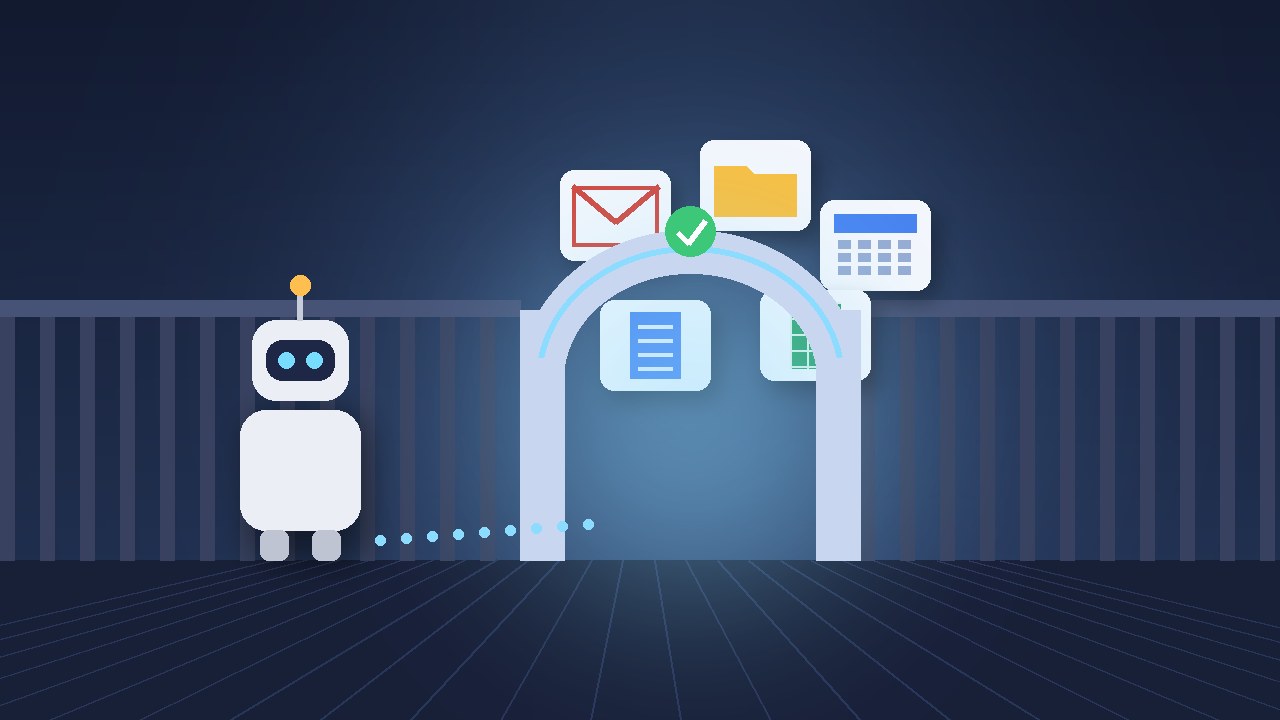
The MCP servers are hosted by Google and cover Gmail, Drive, Docs, Sheets, Slides, Calendar, Chat and Tasks, with Keep "coming soon." The CLI is for terminal agents, VMs and sandboxes. Google says both reach all Workspace domains within two weeks. A Google Cloud blog post ↗ gave the reason: REST APIs "were built for human-paced apps where a valid OAuth token implied user intent," and agents acting "at machine speed" break that assumption. The Next Web ↗ and Real Python ↗ covered the change. The image above is an original illustration by aitoolranked.
The dates and limits that matter
From Google's usage tiers page ↗:
| Date | What changes |
|---|
| Nov 24, 2026 | MCP servers and CLI GA. Standard (free) and Scaled tiers launch. The Workspace AI Tools Addendum ↗ is published. |
| Feb 1, 2027 | The addendum takes effect. Agents that still call REST APIs directly are held to Standard tier quotas, whatever tier the project picked. |
| Apr 1, 2027 | Quota enforcement and Scaled tier billing start. Projects that haven't opted in drop to Standard limits. |
Standard tier: each GA MCP server allows up to 5,000 requests per day, per project, per product, with no billing account needed.
Scaled tier: REST usage is billed above a daily free allowance. Scaled tier Gmail, Calendar and Drive MCP usage has no free allowance and "is billed from the first request."
Agent OAuth clients: OAuth clients used by agents must have "Use this client for an AI-powered agent" selected. Google says the MCP servers reject non-agent clients, and non-agent features should use a separate client.
Human approval: admins can require users to confirm sensitive actions. The Next Web lists sending email, changing Drive sharing and bulk edits. DLP rules and audit logs apply to agent calls automatically.
The addendum also sets data rules. Agents may only process data "to fulfill active, user-authorized tasks". Derived "Google Technical Information," including "vector embeddings, memory indexes, user profiles," can't be stored for more than 30 days. Nothing may be kept after the user disconnects. Workspace data can't be used for "model training, fine-tuning, evaluation dataset building, or model distillation," or to build a product "similar to a GWS Service."
The Gmail send confusion
The loudest complaint was about email. A Tech Stackups piece ↗ titled "The Gmail One Can't Send Email" reached 282 points on Hacker News ↗. At launch, Google's Gmail quota docs marked send, reply and forward as partner-only. As of November 27, Google's Gmail MCP setup guide ↗ says agents can "send, reply to, and forward emails." It now explains how this works: the main /mcp/v1 endpoint exposes every tool but needs a client that supports MCP form elicitation (approval prompts). The fallback /mcp/v1self endpoint drops tools that always need approval. A DEV Community checklist ↗ tracked the doc change. Google hasn't explained it publicly, so check tools/list on your own project before you build on it.
What developers are saying
"Traditional REST APIs were built for human-paced apps. Now AI agents get a standard path into Workspace with DLP checks and human in the loop controls." — Google's Chandu Thota, on X ↗
rclone maintainer nickcw wrote on HN ↗ that the project's shared Drive client is "something like 400x over quota" and that Google's estimator priced the Scaled tier at "$130k/month," which is "a little out of budget for an open source project."
"MCP already has a primitive for exactly this: elicitation lets a server pause a tool call and ask the user to confirm." — perdy on HN ↗, arguing that partner-only sending looked like "a business decision"
"In my eyes, this looks exactly like an anti-spam thing." — MBCook on HN ↗
"The only real limit is the 5k requests which... just seems fair." — blfr on HN ↗
Our take
Most solo builders will be fine. Shared tools will get hurt. Five thousand requests a day per product is plenty for a personal agent that triages your inbox. The limit is per project, though, and some Gmail tools cost more than one request (the DEV checklist cites search_threads and list_drafts at 10 each). An app with hundreds of users on one client ID runs out quickly, and after April 1 it pays from the first MCP call. rclone's numbers show who gets hit hardest: free and open-source tools that share one client ID.
What to do before February 1:
List every Workspace integration and mark the ones where a model decides which call to make. The addendum's definitions of "AI Agent" and "AI Harness" are broad, so a small script that passes your inbox to an LLM likely counts.
Split OAuth clients. Keep non-agent sync jobs on their own client and create agent-flagged clients for the rest.
Check your host supports elicitation if you need send, share or delete. If it doesn't, you'll be on /mcp/v1self with fewer tools.
Put a 30-day expiry on embeddings and memory built from Workspace data, and delete them when a user disconnects.
Open the new usage dashboard in the Cloud console and decide on the Scaled tier before April 1.
How it compares. It's the same move other platforms are making: fence agents into an official, approval-gated channel and price heavy use. OpenAI did something similar with its router and gateway approval rule, and Anthropic is building approval into MCP itself with Skills over MCP and elicitation. If you're new to the protocol, start with our MCP tutorial. If you're picking a stack, our AI agent frameworks comparison and no-code agent builders review list the tools that will need to move to these servers first.