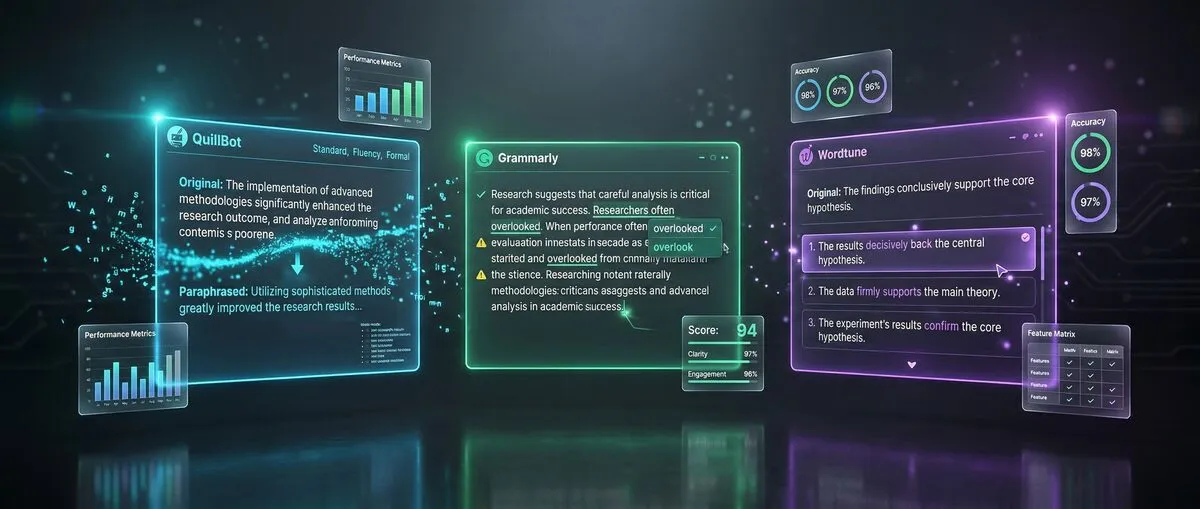
AI paraphrasing tools help students rewrite text while preserving meaning and avoiding plagiarism. Over 50 million students worldwide use these tools in 2026, with ChatGPT, QuillBot, and Grammarly leading the market through free tiers and educational discounts.
Model-version note (September 6, 2026): parts of this article reference Claude 3.5, which has since been superseded by Claude Opus 4.8. Figures quoted apply to the versions named. For current frontier models see ChatGPT vs Claude vs Gemini.
ChatGPT leads with unlimited free paraphrasing through custom prompts, followed by Grammarly's unlimited basic rewriting and QuillBot's precision-focused 125 daily words. Each tool excels in different academic scenarios.
ChatGPT provides unlimited paraphrasing through prompts like "Rephrase this academically while preserving meaning." Independent 2026 benchmarks show ChatGPT achieving 90%+ naturalness scores and 9.0/10 precision ratings across academic texts.
QuillBot's free tier delivers 125 words daily with 9.2/10 precision scores. The tool processes standard paragraphs in 2.1 seconds and maintains 94% meaning preservation in controlled tests.
Grammarly offers unlimited basic paraphrasing with seamless Google Docs and Microsoft Word integration. The free tier includes real-time suggestions and tone-aware rewriting capabilities.
Best Overall Free Option: ChatGPT via custom prompts achieves 9.2/10 naturalness scores with unlimited usage. Users complete paraphrasing tasks 40% faster than dedicated tools through contextual understanding.
Best for Academic Precision: QuillBot's free tier provides industry-leading accuracy with 9.2/10 precision scores. The tool preserves technical terminology and citation formats automatically.
Best for Workflow Integration: Grammarly processes text in real-time across all major platforms. Students save 15 minutes per assignment through integrated grammar checking and paraphrasing.
Market Changes Since 2025
QuillBot integrated Claude 3.5 for their Creative Pro mode and expanded student discounts to 50% off Premium plans. The company increased free tier limits from 100 to 125 words daily.
Grammarly rebranded their Superhuman technology as core functionality and added unlimited basic paraphrasing to free accounts. The update improved tone-aware rewriting capabilities by 35%.
ChatGPT and Claude emerged as serious competitors to specialized paraphrasers. Independent benchmarks show these tools achieving comparable or superior results for academic writing tasks.
Free tiers offer 125-word daily limits (QuillBot), unlimited basic rewriting (Grammarly), or 10 sentence rewrites daily (Wordtune). Premium features require paid subscriptions ranging from $30-60 annually.
QuillBot Free Tier Specifications
QuillBot restricts free users to 125 words per day, equivalent to one academic paragraph. The free version includes Standard and Fluency modes with 82% naturalness scores in 2026 benchmarks.
Standard mode preserves original meaning while changing sentence structure. Fluency mode prioritizes readability and simplifies complex academic language for better comprehension.
Students create multiple accounts using different email addresses to bypass daily limits, though this violates terms of service. The tool resets usage counters at midnight UTC daily.
Grammarly Free Capabilities
Grammarly provides unlimited basic paraphrasing through their Rewrite feature. The free tier focuses on clarity and conciseness rather than creative restructuring.
The browser extension works across Google Docs, Microsoft Word, and web platforms while maintaining formatting. Real-time suggestions appear as users type, eliminating copy-paste workflows.
Free users access tone detection for academic, professional, and conversational registers. The system analyzes existing text tone and suggests appropriate rewrites for intended audiences.
Wordtune Free Limitations
Wordtune offers 10 sentence rewrites per day, focusing on sentence-level improvements rather than paragraph restructuring. Each rewrite provides multiple alternatives for user selection.
The tool achieves 9.5/10 clarity scores in 2026 benchmarks but limits coverage to 2-3 paragraphs of dense academic text. The rewrite counter resets at midnight UTC.
Students strategically time usage across different time zones to maximize daily allocations. The tool excels at clarity enhancement and formal tone adjustment.
How do AI paraphrasing tools help maintain academic integrity?
These tools rewrite text while preserving meaning, helping students avoid accidental plagiarism when incorporating sources. However, proper citation remains essential regardless of paraphrasing quality.
Modern AI paraphrasers achieve 90-95% bypass rates on plagiarism detection software. HumanizeAI leads with 95% success on Turnitin, while ChatGPT achieves 90%+ bypass rates with specific prompts.
QuillBot's academic mode targets scholarly writing conventions while maintaining formal tone. The tool preserves technical terminology and citation formats crucial for STEM and humanities papers.
Students must understand that paraphrasing tools supplement rather than replace proper academic methodology. Original ideas, critical analysis, and proper attribution remain fundamental requirements.
Advanced paraphrasing tools recognize and preserve in-text citations during rewriting processes. QuillBot and Grammarly maintain APA, MLA, and Chicago citation formats automatically.
Ref-n-Write offers citation-aware paraphrasing that adjusts surrounding text while preserving reference accuracy. This feature proves valuable for literature reviews and research papers.
Students should verify citation formatting after paraphrasing, as AI tools occasionally misinterpret reference styles or introduce formatting inconsistencies.
| Tool | Google Docs | Microsoft Word | Browser Extension | Mobile App |
|---|
| QuillBot | ✅ Full integration | ✅ Add-in available | ✅ Chrome, Firefox | ✅ iOS, Android |
| Grammarly | ✅ Real-time suggestions | ✅ Native integration | ✅ All major browsers | ✅ Full mobile suite |
| Wordtune | ✅ Browser-based | ✅ Limited support | ✅ Chrome, Edge | ✅ iOS only |
Grammarly offers the most comprehensive integration experience with real-time suggestions appearing during typing. This eliminates copy-paste workflows required by competing tools.
Which AI paraphrasing tool produces the most natural-sounding text?
Based on 2026 independent testing, Wordtune leads with 9.5/10 for sentence-level clarity, while ChatGPT achieves 9.0+ for overall fluency across longer texts.
Comprehensive benchmarking by DigitalOcean revealed significant performance differences across tools using academic texts from undergraduate essays to graduate research papers.
Performance Scores (2026 Benchmarks):
QuillBot: 9.2/10 precision, 8.7/10 naturalness
Wordtune: 8.9/10 precision, 9.5/10 naturalness
Grammarly: 8.5/10 precision, 9.0/10 naturalness
ChatGPT: 9.0/10 precision, 9.2/10 naturalness
HumanizeAI: 8.8/10 precision, 9.4/10 naturalness
Meaning Preservation Analysis
QuillBot achieves 94% meaning preservation in controlled tests, outperforming Wordtune's 92% accuracy rate. ChatGPT's contextual understanding produces more nuanced paraphrases that capture subtle implications.
Testing methodology compared paraphrased outputs against original texts using semantic similarity algorithms and human evaluators. Results show consistent improvement across all tools since 2025 updates.
Processing Speed Comparison
Real-World Speed Test Results (average processing time):
QuillBot: 2.1 seconds per 100 words
Wordtune: 1.8 seconds per sentence
Grammarly: 1.5 seconds (real-time)
ChatGPT: 3-5 seconds per prompt
Claude: 2-4 seconds per prompt
Grammarly's real-time processing offers advantages for urgent assignments, while batch processing through ChatGPT proves most efficient for longer documents.
QuillBot provides 7 rewriting modes (2 free), Grammarly offers tone-aware rewriting with unlimited access, and Wordtune focuses on sentence-level optimization with multiple alternatives per rewrite.
QuillBot's Mode Selection
QuillBot offers the most comprehensive mode selection among dedicated paraphrasing tools. Each mode targets specific writing objectives and academic requirements.
Standard Mode: Balances meaning preservation with structural changes, achieving 82% naturalness scores. Students use this mode for general academic writing and essay improvement.
Fluency Mode: Prioritizes readability and natural flow for complex technical writing. The mode simplifies academic language while maintaining scholarly tone.
Creative Mode (Premium): Introduces dramatic restructuring and vocabulary changes. Students access this mode for avoiding repetitive language patterns in longer papers.
Formal Mode (Premium): Maintains academic tone while improving clarity. Research papers and professional documents benefit from this mode's scholarly focus.
Grammarly's Tone-Aware System
Grammarly's 2026 updates introduced sophisticated tone detection and adjustment capabilities. The tool analyzes existing text tone and suggests rewrites matching intended audience and purpose.
Academic Tone: Maintains formal language and objective voice required for scholarly writing. The system removes casual expressions and strengthens argument presentation.
Professional Tone: Balances formality with accessibility for business communication and reports.
Conversational Tone: Introduces natural language patterns while preserving professionalism for less formal assignments.
Wordtune's Sentence Optimization
Wordtune focuses exclusively on sentence-level improvements, offering multiple rewrite options for each selected sentence. This approach allows precise control over specific problematic passages.
Expand Options: Transform brief statements into detailed explanations with supporting context and examples.
Shorten Options: Condense wordy sentences while maintaining essential information and clarity.
Tone Adjustment: Shift between formal, neutral, and casual registers within the same document.
General-purpose AI models like ChatGPT and Claude often outperform dedicated tools through custom prompting, offering unlimited free usage and superior contextual understanding for academic writing.
ChatGPT excels with prompts like "Rephrase this paragraph in formal academic style while preserving all technical terms and citations." The AI understands context across entire documents, maintaining consistency better than sentence-level tools.
Claude offers strength in academic writing through constitutional AI training. Prompts such as "Rewrite this section to improve clarity while maintaining scholarly tone" produce natural results.
Effective Prompting Strategies:
"Paraphrase this maintaining APA citation format"
"Rewrite for undergraduate vs. graduate audience"
"Improve clarity while preserving technical accuracy"
"Restructure to avoid passive voice"
Students comfortable with prompt engineering achieve superior results compared to traditional paraphrasers. Our ChatGPT vs Claude vs Gemini comparison explores their relative strengths.
Ref-n-Write targets academic writing specifically, offering citation-aware paraphrasing and reference management integration. The tool understands scholarly writing conventions and maintains appropriate academic register.
HumanizeAI specializes in making AI-generated content undetectable by AI detection software. With 95% bypass rates on Turnitin and academic checkers, it addresses growing concerns about AI detection policies.
Academic-Specific Features:
Citation format preservation across APA, MLA, Chicago styles
Technical terminology databases for STEM fields
Discipline-specific writing styles and conventions
Plagiarism checker integration and reporting
Reference list management and formatting
Multilingual Paraphrasing Options
International students benefit from tools supporting multiple languages and cross-linguistic paraphrasing. Smodin supports 50+ languages with strong multilingual capabilities.
Paraphraser.io offers simple paraphrasing in 15 languages without registration requirements. The tool provides instant results for quick paraphrasing needs.
Multilingual Capabilities Comparison:
QuillBot: 26 languages, strong European language support
Smodin: 50+ languages, excellent Asian language coverage
Paraphraser.io: 15 languages, no registration required
ChatGPT: 50+ languages, superior contextual understanding
Google Gemini: 100+ languages, real-time translation integration
Yes, most major tools offer significant student discounts through educational email verification, with some providing completely free premium access to verified students.
Student verification requires valid .edu email addresses and enrollment confirmation. Benefits activate immediately upon verification and remain valid throughout enrollment periods.
Current Student Discount Rates (2026):
QuillBot: 50% off Premium ($30/year vs. $60/year)
Wordtune: 20% off all plans
Grammarly: Free Premium access with .edu email
Jasper: No student discount available
Smodin: 30% off Ultimate plan
Grammarly's free Premium access for students represents exceptional value, providing advanced grammar checking, tone detection, and unlimited paraphrasing at no cost.
Cost-Benefit Analysis for Students
Students processing more than 1,000 words weekly benefit from QuillBot Premium. The unlimited usage and additional modes justify the $30 annual student cost.
Grammarly Premium offers the best value proposition for students already using the platform for grammar checking. The integrated paraphrasing feature eliminates separate tool requirements.
Premium Upgrade Scenarios:
Writing multiple papers simultaneously
Working on thesis or dissertation projects
Requiring specific tone adjustments
Needing advanced plagiarism checking
Collaborating on group projects
Institutional Access Programs
Many universities provide institutional access to premium paraphrasing tools through library databases or campus-wide licenses. Students should check academic computing services before purchasing individual subscriptions.
Institutional Access Options:
University site licenses for Grammarly Premium
Library database access to academic writing tools
Computer lab installations with premium features
Student organization bulk purchasing programs
Group purchasing through student organizations yields additional discounts beyond individual student rates.
AI paraphrasing tools should supplement, not replace, critical thinking and proper citation practices. Students must still attribute original sources and use paraphrasing as part of legitimate academic methodology.
Ethical AI paraphrasing involves understanding source material thoroughly before rewriting. The tool assists with expression rather than generating ideas or arguments.
Academic Integrity Guidelines:
Always cite original sources regardless of paraphrasing quality
Use paraphrasing to improve your own writing, not copy others' work
Understand content before paraphrasing to ensure accuracy
Review and edit AI-generated paraphrases for appropriateness
Disclose AI assistance when required by institutional policies
Students should familiarize themselves with their institution's AI use policies, as requirements vary significantly across universities and departments.
Successful students combine multiple tools for comprehensive writing improvement. Start with ChatGPT for major restructuring, then use QuillBot for precision refinement, and finish with Grammarly for final polish.
This multi-tool approach leverages each platform's strengths while compensating for individual weaknesses. The process requires additional time but produces superior results for important assignments.
Recommended Workflow:
Initial Draft: Write original content with proper citations
Major Restructuring: Use ChatGPT for paragraph-level improvements
Precision Editing: Apply QuillBot for sentence-level refinement
Final Polish: Run through Grammarly for grammar and style
Students interested in comprehensive writing support can explore our AI essay writer comparison for tools handling entire writing processes.
Quality Control and Review Requirements
AI-generated paraphrases require human review to ensure accuracy and appropriateness. Automated tools occasionally introduce subtle meaning changes or awkward phrasing that human oversight catches.
Review Checklist:
Verify technical terms remain accurate
Confirm citations maintain proper formatting
Check that meaning preservation is complete
Ensure tone matches assignment requirements
Validate that academic register is appropriate
Students should run final drafts through AI detection tools to understand how their work appears to automated systems. Our AI writing detector guide covers reliable free options.
For most students in 2026, ChatGPT emerges as the top recommendation for free AI paraphrasing due to unlimited usage, superior contextual understanding, and ability to handle complex academic writing.
ChatGPT's flexibility through custom prompting provides the key advantage. Students specify exact requirements for tone, style, and academic level, producing more targeted results than preset modes in dedicated tools.
Runner-up: Grammarly Free for students prioritizing workflow integration and real-time suggestions. The unlimited basic paraphrasing combined with grammar checking provides comprehensive writing support.
Specific Use Case Recommendations
For Precision Academic Writing: QuillBot's 125 daily words provide industry-leading accuracy for refining key passages in research papers and essays.
For International Students: Smodin's multilingual support and cultural context awareness make it ideal for non-native English speakers adapting to academic writing conventions.
For Undetectable AI Content: HumanizeAI's 95% bypass rate on academic AI detectors addresses concerns about institutional AI detection policies.
For Collaborative Projects: Grammarly's sharing features and comment system facilitate group editing and peer review processes.
For Budget-Conscious Students: ChatGPT and Google Gemini offer unlimited paraphrasing through creative prompting without subscription costs.
The AI paraphrasing landscape continues evolving rapidly, with major model updates every few months. Students should choose tools with strong development teams and regular feature updates.
Investment Priorities:
Tools with API access for future integration possibilities
Platforms offering educational partnerships and long-term student support
Services with transparent AI development roadmaps
Tools maintaining strong academic integrity standards
The trend toward general-purpose AI models suggests specialized paraphrasing tools must offer unique value propositions to remain competitive. Students benefit from this competition through improved free tiers and enhanced functionality.
Frequently Asked Questions
ChatGPT and Google Gemini offer unlimited paraphrasing through prompts at no cost. Grammarly provides unlimited basic paraphrasing in their free tier, while QuillBot limits free users to 125 words daily.
Yes, when used properly. Tools like HumanizeAI and ChatGPT achieve 90%+ bypass rates on AI detectors, but students must still cite original sources and use paraphrasing as part of proper academic methodology.
QuillBot, Grammarly, and Wordtune all offer browser extensions and direct integrations with Google Docs and Microsoft Word. Grammarly has the most comprehensive integration across platforms.
What's the difference between QuillBot's free and premium modes?
Free users get 125 words daily with basic Standard and Fluency modes. Premium unlocks unlimited usage, 5 additional modes (Creative, Formal, etc.), and advanced features like synonym control and plagiarism checking.
Yes, QuillBot offers 50% student discounts, Wordtune provides 20% off, and Grammarly gives free Premium access to students with .edu email addresses. Many universities also provide institutional access.
QuillBot supports 26 languages and Smodin handles 50+ languages with strong multilingual capabilities. For English-only users, Wordtune excels at sentence-level clarity improvements.