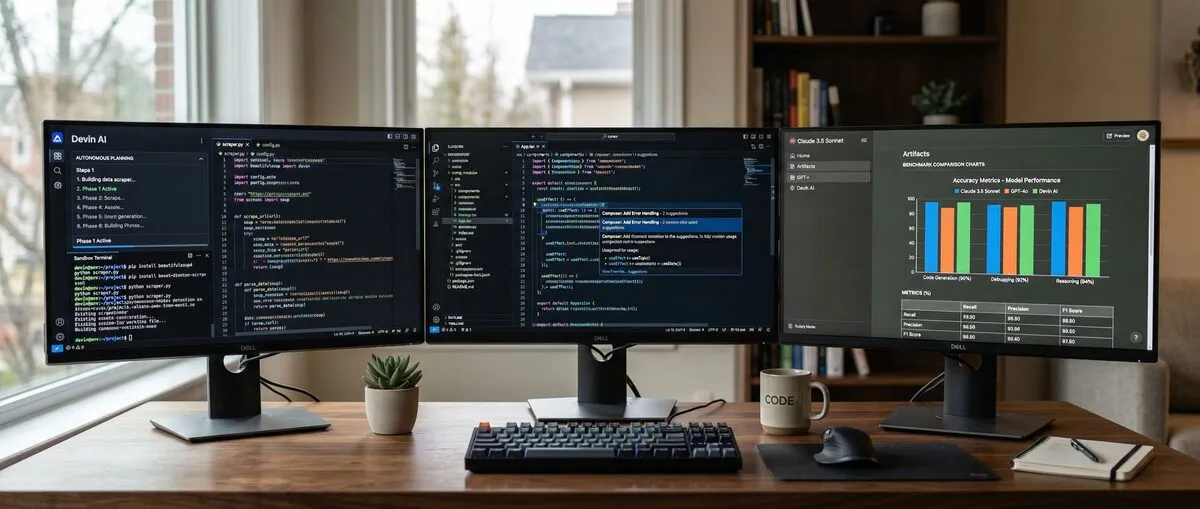
Cognition Labs launched Devin in March 2024 ↗. Devin self-reported a 13.86% resolution rate on a 570-issue subset of SWE-bench. Devin AI plans tasks, works inside a sandboxed environment with a shell, browser and code editor, and can run several Devin sessions in parallel for end-to-end software engineering tasks.
Key facts
| Fact | Value | Source | Checked on |
|---|
| Launch | March 12, 2024, announced as "the first AI software engineer" | Introducing Devin ↗ | 2026-09-24 |
| SWE-bench result (self-reported) | 13.86%, 79 of 570 issues resolved, 45-minute limit per task | SWE-bench technical report ↗ | 2026-09-24 |
| Prior baselines cited by Cognition | 1.96% unassisted, 4.80% assisted | SWE-bench technical report ↗ | 2026-09-24 |
| Independent trial | Answer.AI, January 2025: 3 successes, 14 failures, 3 inconclusive out of 20 tasks | Thoughts on a month with Devin ↗ | 2026-09-24 |
| Plans | Free $0; Pro $20/month; Max $200/month; Teams $80/month plus $40 per full dev seat; Enterprise custom | Devin pricing ↗ | 2026-09-24 |
| Surfaces | Devin Cloud, Devin Desktop and a CLI | Devin pricing ↗ | 2026-09-24 |
| GitHub Copilot, for comparison | Pro $10/month; Business $19 per seat/month | GitHub Copilot plans ↗ | 2026-09-24 |
Updated 2026-09-24: added Key facts, question headings with direct answers, and an FAQ built from the questions Google shows for this topic.
What does the 2026 AI coding landscape look like?
Devin AI offers autonomous planning and sandbox execution. Cursor provides multi-file agent edits inside a VS Code fork. GitHub Copilot costs $19 per user per month on the Business plan (as of September 2026). Claude adds Artifacts previews and Computer Use (introduced October 2024), with a $20 monthly Pro tier. Open-source Aider, OpenHands (formerly OpenDevin), SWE-agent and Continue enable free self-hosted agentic coding. This Devin AI review compares Devin with these tools using vendor documentation and published evaluations.
Devin AI sits at the high-autonomy end of 2026 coding tools. Cursor indexes entire codebases for context-aware refactors. GitHub Copilot integrates with VS Code, JetBrains and Neovim. Claude is widely used for complex reasoning and code explanation. Aider edits local repositories through git-aware diff commands. OpenHands replicates Devin-style agents in open source form. SWE-agent optimizes scaffolding specifically for repository-level benchmarks. Continue supplies customizable agents inside standard IDEs. Replit Agent builds and deploys full applications from natural language inside browser-based environments. Amazon Q Developer offers code transformation for Java upgrades inside AWS accounts.
What is Devin AI and how does it work?
Devin AI is Cognition Labs' autonomous coding agent, launched in March 2024 as "the first AI software engineer." It plans a task, then executes it inside a sandbox with a shell, browser and code editor, and returns the result as a pull request. As of September 2026 it sells self-serve plans from a free tier to a $200 Max plan.
Cognition Labs positioned Devin AI against chat-based coding assistants. Devin AI decomposes user requests into sequential subtasks. Devin AI launches isolated shell sessions to run commands. Devin AI opens browser instances to consult documentation. Devin AI modifies multiple files through its internal editor. Devin AI iterates on failures by reading error output and retrying. Devin AI outputs completed features or fixes as pull requests for human review. Access is no longer waitlist-only: the Devin pricing page ↗ lists Free, Pro, Max, Teams and Enterprise plans as of September 2026.
What happened to Devin AI from its 2024 launch through 2026?
Cognition Labs published its SWE-bench technical report in March 2024. An independent one-month trial by Answer.AI, published in January 2025, produced mixed real-world results. In April 2025, Cognition released Devin 2.0 with parallel Devins, Interactive Planning, Devin Wiki and a plan starting at $20. Devin AI retained its core sandbox architecture through 2026.
What core architecture powers Devin AI?
Devin AI decomposes goals into steps and, since Devin 2.0, proposes a plan the user can edit before work starts. Devin AI indexes connected repositories into an auto-generated wiki. Devin AI can run multiple sessions in parallel, each with its own cloud IDE. Devin AI limits external dependencies through contained tool environments. Devin AI delivers its work as pull requests that humans review.
What published benchmarks exist for Devin AI?
The main published benchmark for Devin AI is Cognition's own March 2024 SWE-bench technical report. Cognition evaluated Devin on a random 25% subset of the SWE-bench test set (570 of 2,294 issues from real GitHub repositories). Devin ran unassisted, finding the relevant files itself, with a 45-minute runtime limit per task. The result is self-reported by Cognition.
Each SWE-bench task pairs a real GitHub issue with the repository at that point in time. A task counts as resolved only when the generated patch makes the repository's hidden tests pass. Cognition compared Devin with earlier results that were produced by language models rather than agents, so the comparison is not like-for-like. Independent evidence is limited; the best-known public account is Answer.AI's January 2025 write-up of 20 tasks attempted over one month. All benchmark data in this review traces to those two sources.
Devin AI resolved 13.86% of SWE-bench instances (79 of 570) in Cognition Labs' self-reported March 2024 technical report ↗, against prior baselines of 1.96% unassisted and 4.80% assisted. Answer.AI's independent January 2025 trial found it succeeded on 3 of 20 real tasks. Newer agents report far higher SWE-bench scores, so treat the 2024 figure as a historical milestone.
In Answer.AI's trial, Devin succeeded on 3 of 20 tasks, failed 14 and left 3 inconclusive ↗. The testers reported that Devin sometimes kept pursuing approaches that could not work instead of flagging a blocker. Devin did best on small, clearly defined tasks. See our Best AI for Coding 2026 developer guide for broader context across other tools.
Devin AI works mainly inside its own cloud sandbox, and as of September 2026 the Devin pricing page also lists Devin Desktop and a CLI. Devin AI executes Git commands, runs tests, opens browsers and edits files inside isolated environments. Devin AI delivers final changes as pull requests for human merge. Independent reports describe friction with large or unusual codebases and with tasks outside Devin's supported tooling. Devin AI suits self-contained tasks on standard technology stacks.
Devin AI clones repositories into its sandbox on task start. Devin AI runs package install commands as part of setup. Devin AI opens pull requests when a task is complete. According to Devin's documentation ↗, teams can assign work by tagging Devin in Slack or Microsoft Teams threads or from Linear and Jira tickets. Teams route Devin AI outputs through existing CI/CD pipelines. Our AI coding tools guide for 2026 examines additional integration patterns.
How does Devin AI compare to Cursor, GitHub Copilot, Claude, Aider and OpenHands?
Devin AI provides high autonomy through planning and sandbox execution, while Cursor focuses on fast multi-file iteration inside its AI-first IDE. GitHub Copilot offers mature GitHub ecosystem integration; its Copilot Workspace technical preview has ended, and GitHub Next archived the project's user manual on September 2, 2025. Claude offers Artifacts and Computer Use browser control. Aider supplies terminal-based git edits. OpenHands offers an open-source implementation of agent patterns. The 2026 choice depends on required autonomy level, IDE preference and budget.
| Tool | Pricing (as of September 2026) | Autonomy Level | Key Differentiator | Best Use Case |
|---|
| Devin AI | Free; Pro $20/mo; Max $200/mo; Teams $80/mo + $40/seat; Enterprise custom | High (sandbox + parallel sessions) | Long-horizon planning and execution | Well-scoped end-to-end tasks |
| Cursor | Free Hobby, $20/mo Pro | Medium-High (agent mode) | AI-first VS Code fork with codebase context | Rapid multi-file refactors |
| GitHub Copilot | $10/mo Pro, $19/user Business | Medium | Deep GitHub ecosystem integration | Teams on GitHub |
| Claude | $20/mo Pro, usage-based API | High (Computer Use API since Oct 2024) | Reasoning and code explanation | Complex logic and architecture |
| Aider | Free (own API keys) | Medium (terminal-based) | Git-aware diff editing with voice mode | Local repository power users |
| OpenHands | Free/self-hosted | Medium-High (sandboxed agents) | Transparent open-source implementation | Research and customization |
| Replit Agent | From $20/mo (Core) | Medium | Prompt-to-deploy in browser IDE | Rapid prototyping |
| Continue | Free/open-source | Medium | Customizable agents in standard IDEs | Privacy-focused teams |
| Amazon Q Developer | Free tier, $19/user/mo Pro | Medium | Java upgrade transformation | AWS enterprise environments |
Additional tools show distinct attributes. SWE-agent, from Princeton and Stanford researchers, targets repository-level benchmark tasks and is open source.
Consult our Claude Code Review 2026 analysis versus GitHub Copilot and Cursor AI for a deeper look at those tools.
What limitations does Devin AI have compared to human engineers?
Devin AI needs human intervention on novel problems, architectural decisions and tasks that depend on deep context about a specific codebase or business. In Answer.AI's independent trial, 14 of 20 tasks failed. Devin has no view of business tradeoffs beyond what it is told, so engineers still own ambiguous requirements, cross-domain knowledge and final accountability.
Devin AI can struggle with undocumented internal APIs. Like other LLM-based tools, Devin AI can generate plausible but incorrect logic in unfamiliar domains. Devin AI cannot negotiate tradeoffs across business constraints. Teams get better results when engineers define precise specifications and review all outputs. Available public evidence suggests Devin AI augments rather than replaces human engineers on complex projects.
What productivity impact and ROI does Devin AI deliver?
Devin AI's productivity impact depends on task type and review overhead, and no independent study has published reliable time-savings figures. Cognition positions Devin for repetitive bug fixes, migrations and standard feature additions. A simple calculation framework multiplies task frequency by time saved, then subtracts review overhead and subscription cost. Running many parallel sessions also increases the review load on the humans who merge the work.
Some teams pair Devin AI with an IDE assistant such as Cursor for iteration and use human review for final checks. Researchers studying autonomous systems can compare Devin's behavior with open-source agents such as OpenHands and SWE-agent. Adoption requires process changes to accommodate AI-generated code review steps. Whether ROI is positive depends on how much engineer time the reviewed pull requests actually save relative to plan cost.
Who should use Devin AI in 2026?
Engineering teams with repetitive, well-scoped tasks and a human review step are the best fit for Devin AI. Mature CI/CD and clear acceptance criteria make its pull requests easier to verify. Teams that want rapid prototyping or deep IDE integration usually prefer Cursor or GitHub Copilot. Devin is strongest on autonomy and weakest on loosely specified work.
Developers focused exclusively on local workflows select Aider. Students and individual learners can see our Best Free AI Coding Tools for Students 2026 guide. Enterprises inside AWS often choose Amazon Q Developer. Teams prioritizing reasoning depth use Claude.
What is the future of autonomous AI software engineering?
Agentic tools are converging on the same pattern Devin introduced: planning, sandboxed execution and pull-request output, combined with newer reasoning models and tighter IDE integration. OpenHands community contributions support reproducible research. Hybrid workflows that route simple tasks to autonomous agents and complex decisions to humans are becoming common. Public benchmarks such as SWE-bench remain the main way to compare capability gains across tools.
FAQ
Does Devin AI really work?
It works on small, clearly defined tasks and struggles beyond them, on the public evidence. Cognition's own March 2024 report shows 13.86% of a 570-issue SWE-bench subset resolved. Answer.AI's independent month-long trial recorded 3 successes, 14 failures and 3 inconclusive results across 20 tasks. Expect useful pull requests only with tight specifications and human review.
What is Devin AI?
Devin AI, developed by Cognition Labs, is marketed as the first AI software engineer. Unlike traditional coding assistants, it can plan and execute complex tasks end-to-end using a sandboxed environment with tools like a shell, browser, and code editor. As of September 2026, it is available on self-serve plans as well as Enterprise contracts.
In its March 2024 technical report, Cognition reported that Devin resolved 13.86% of a 570-issue SWE-bench subset, a notable improvement over the prior state-of-the-art results it cited at the time. Answer.AI's independent January 2025 trial found it handled small, structured tasks but often needed oversight for complex, real-world work.
Devin offers higher autonomy through planning and execution in a sandbox, while Cursor focuses on multi-file editing in an AI-first IDE and Copilot provides mature GitHub integration. The best choice depends on your workflow: Devin for delegated, well-scoped tasks, Cursor for rapid iteration, and Copilot for ecosystem depth. Our comparison table details the tradeoffs.
What are the main limitations of Devin AI compared to human engineers?
Devin still struggles with novel problems, nuanced architectural decisions, and tasks requiring deep contextual understanding of a codebase. Answer.AI's trial showed mixed results, with 3 successes out of 20 tasks. It augments rather than fully replaces human engineers in most complex projects.
How much does it cost to use Devin AI?
As of September 2026, Devin's pricing page lists a Free plan, Pro at $20/month, Max at $200/month, Teams at $80/month plus $40/month per seat, and custom Enterprise pricing. For comparison, Cursor Pro and Claude Pro are $20/month, while GitHub Copilot is $10/month (Pro) or $19/user/month (Business). Check the vendor pages for current limits, since plans change often.
Should development teams adopt Devin AI?
Teams focused on accelerating specific, well-defined workflows or exploring agentic systems may see productivity gains, especially when combined with human review. The strongest fit is repetitive or well-scoped tasks with clear acceptance criteria. Start with a small pilot on the Free or Pro plan before committing to a team plan.
Sources