What are AI voice generators in 2026?
AI voice generators synthesize realistic speech from text using neural networks. ElevenLabs is known for voice cloning and creative features, cloud services from Google, Microsoft and Amazon lead on scale and per-character pricing, and newer models from Cartesia and Google top independent listener rankings as of September 2026. Trends include prompt-controlled emotion, multilingual voices and low-latency models for voice agents.
Amazon Polly's free tier covers 5 million standard-voice characters a month for the first 12 months. ElevenLabs' Eleven v3 model accepts audio tags such as [whispers] or [excited] to control emotion. Google Cloud Text-to-Speech offers several voice families, from Standard and WaveNet to Chirp 3 HD and Gemini-TTS. Microsoft Azure AI Speech can create a personal voice from a 5 to 90 second sample plus a recorded consent statement. OpenAI's gpt-4o-mini-tts model can be steered with instructions for tone, accent and pacing. Common uses include podcasts, narration, voice agents and accessibility features. Ethical cloning requires consent, as in Azure's personal voice. Naturalness is compared on public leaderboards such as the Artificial Analysis Speech Arena.
How do published benchmarks compare the best AI voice generators?
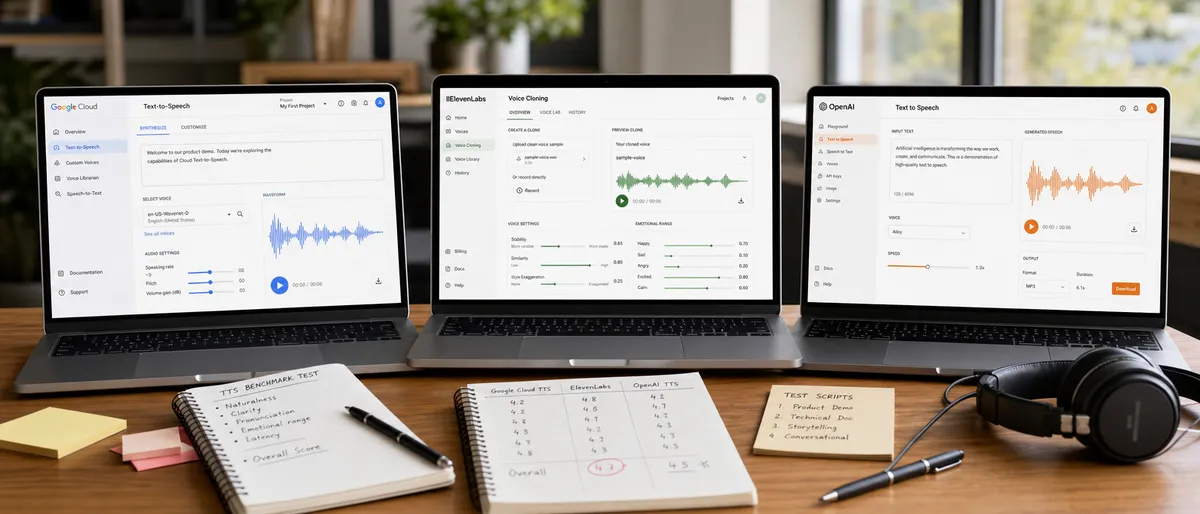
The main public benchmark is the Artificial Analysis Speech Arena, which ranks text-to-speech models by Elo from blind listener votes. As of September 2026, Cartesia's Sonic 3.6 ranked first, Google's Gemini 3.1 Flash TTS 8th, ElevenLabs v3 Conversational 10th, Murf Falcon 2 16th, Azure HD 2.5 21st, OpenAI TTS-1 HD 30th and Amazon Polly Generative 49th.
Benchmark Criteria
The Artificial Analysis Speech Arena ↗ plays listeners two samples generated from the same text and asks which sounds more natural, without revealing the model. Results are aggregated into Elo scores. Beyond naturalness, the practical criteria are latency (vendor-stated), language coverage, pricing per character or per plan, and safeguards such as consent checks for voice cloning.
Methodology and Limitations
The arena measures listener preference for naturalness only. It does not measure pronunciation of technical terms, long-form consistency, latency or cost, and scores change as votes are added. Latency figures in this article are vendor-stated and usually exclude network time. Prices are taken from vendor pricing pages as of September 2026.
Top AI voice generators include ElevenLabs for voice cloning and expressive narration from $6/month, Google Cloud Text-to-Speech from $4 to $160 per 1M characters depending on voice type, OpenAI's TTS models with instruction-based steering, Microsoft Azure AI Speech for custom and personal voices, Amazon Polly at $4 to $100 per 1M characters, and Murf for studio voiceovers (pricing as of September 2026).
ElevenLabs: Voice Cloning and Expressive Speech
ElevenLabs' Instant Voice Cloning works from about 1 to 2 minutes of audio, and Professional Voice Cloning uses 30 minutes or more. Eleven v3 supports 70+ languages and audio tags for emotion. After a free plan with 10,000 credits, paid pricing starts at $6/month for 30,000 credits on the Starter plan (as of September 2026, per ElevenLabs' pricing page ↗). Pros include expressive voices and a wide model range. Its best model ranked 10th on the Speech Arena as of September 2026. Cons include costs that add up at high volume. Developers integrate via a REST API, and the Flash v2.5 model has about 75ms model latency, excluding network time.
Google Cloud Text-to-Speech: Versatile Enterprise Choice
Google Cloud Text-to-Speech offers Standard, WaveNet, Neural2, Studio, Chirp 3 HD and Gemini-TTS voices. As of September 2026, Google's pricing page ↗ lists Standard and WaveNet at $4 per 1M characters after 4M free characters a month, Neural2 at $16, Chirp 3 HD at $30 and Studio at $160 per 1M characters after 1M free. Instant custom voice costs $60 per 1M characters. Gemini 3.1 Flash TTS ranked 8th on the Speech Arena as of September 2026. Enterprises use it for scalable narration in apps.
OpenAI TTS: LLM-Powered Dynamic Narration
OpenAI offers three text-to-speech models: gpt-4o-mini-tts, tts-1 for lower latency and tts-1-hd for higher quality. OpenAI's docs ↗ list 13 built-in voices, including alloy, coral, marin and cedar. Instructions can control accent, emotional range, intonation, speed and tone. Language support follows Whisper and covers 50+ languages, but voices are optimized for English. Output formats include MP3, Opus, AAC, FLAC, WAV and PCM, and audio can stream as it is generated.
Microsoft Azure AI Speech: Custom Voice Training Expert
Azure's personal voice creates a voice from a 5 to 90 second speech sample plus a recorded consent statement from the speaker, and can speak in 91 languages. API access is limited to approved customers and use cases. Professional voice fine-tuning, for brand and character voices, also requires approval. SSML supports emphasis and pauses in outputs. The free F0 tier includes 0.5 million neural voice characters a month. Azure HD 2.5 ranked 21st on the Speech Arena as of September 2026.
Amazon Polly: Scalable AWS Integration
Amazon Polly offers 100+ voices in 40+ languages and language variants across Standard, Neural, Long-Form and Generative engines. As of September 2026, pricing is $4 per 1M characters for Standard, $16 for Neural, $30 for Generative and $100 for Long-Form. The first-12-month free tier covers 5M Standard, 1M Neural, 500,000 Long-Form and 100,000 Generative characters a month. Polly's Generative voice ranked 49th on the Speech Arena as of September 2026. Developers deploy it serverlessly for narration tasks.
Other Notables: Murf.ai, Cartesia and IBM Watson
Murf lists 200+ voices across 35+ languages, and its Falcon 2 API model ranked 16th on the Speech Arena as of September 2026. Murf states under 100ms latency for Falcon and API pricing of $0.01 per minute. Cartesia's Sonic 3.6 ranked first on the Speech Arena as of September 2026. IBM Watson Text to Speech offers a free Lite plan of 10,000 characters a month and a Standard plan from $0.02 per 1,000 characters, and its premium custom voices can be built from about one hour of recordings.
| Tool | Voices / Languages (vendor-stated) | Pricing (as of September 2026) | Key Feature |
|---|
| ElevenLabs | 70+ languages (Eleven v3) | From $6/month (30,000 credits) | Instant and professional cloning |
| Google Cloud TTS | Several voice families | $4-160 per 1M chars, monthly free tier | Gemini-TTS and Chirp 3 HD |
| OpenAI TTS | 13 voices, 50+ languages | See OpenAI pricing | Instruction-steerable speech |
| Microsoft Azure | Personal voice in 91 languages | Free tier 0.5M chars/month | Consent-based personal voice |
| Amazon Polly | 100+ voices, 40+ languages | $4-100 per 1M chars | Four voice engines |
| Murf.ai | 200+ voices, 35+ languages | API $0.01/minute (vendor-stated) | Falcon 2 low-latency API |
| Cartesia | Not listed here | Not listed here | #1 on Speech Arena (Sept 2026) |
| IBM Watson | 16 languages and dialects (Deploy Anywhere) | From $0.02 per 1,000 chars | On-premises deployment |
As of September 2026, Cartesia Sonic 3.6 leads the Speech Arena for naturalness, ElevenLabs Flash v2.5 lists about 75ms model latency, and Amazon Polly and Google Standard voices have the lowest per-character prices in this list at $4 per 1M characters. ElevenLabs Eleven v3 supports 70+ languages, and OpenAI and Gemini-TTS voices can be steered with instructions.
Realism and Naturalness Scores
As of September 2026, the Speech Arena ranks Cartesia Sonic 3.6 first with 1273 Elo. Google's Gemini 3.1 Flash TTS scores 1199 (8th), ElevenLabs v3 Conversational 1196 (10th), Murf Falcon 2 1157 (16th), Azure HD 2.5 1128 (21st), OpenAI TTS-1 HD 1099 (30th) and Amazon Polly Generative 1061 (49th). Older voice types rank lower, such as Google WaveNet (81st) and Polly Standard (90th).
Latency and Cost Efficiency
Vendor-stated model latency, excluding network time: ElevenLabs Flash v2.5 about 75ms and v3 Conversational about 280ms, and Murf Falcon under 100ms. OpenAI's Speech API streams audio as it is generated. Costs as of September 2026: Amazon Polly $4 to $100 per 1M characters, Google $4 to $160 per 1M characters, and ElevenLabs subscriptions from $6/month for 30,000 credits. Per-character cloud pricing is usually cheaper at high volume.
Multilingual and Emotional Capabilities
ElevenLabs Eleven v3 supports 70+ languages with audio tags for emotion. Azure personal voice speaks 91 languages. Amazon Polly covers 40+ languages and variants. OpenAI TTS covers 50+ languages but is optimized for English, and its instructions control emotional range and tone. For AI audio beyond speech, see our guide to the best AI music generators in 2026. The table below compares head-to-head.
| Benchmark (September 2026) | ElevenLabs | Google TTS | OpenAI TTS | Azure | Polly |
|---|
| Best Speech Arena rank | 10 | 8 | 30 | 21 | 49 |
| Best Elo | 1196 | 1199 | 1099 | 1128 | 1061 |
| Languages (vendor-stated) | 70+ (v3) | Varies by voice | 50+ | 91 (personal voice) | 40+ |
| Cost | From $6/month | $4-160 per 1M chars | See OpenAI pricing | Free tier 0.5M chars | $4-100 per 1M chars |
What are the ethical considerations in AI voice generation?
Ethical considerations in AI voice generation center on deepfake risks and consent. Azure's personal voice requires a recorded consent statement, ElevenLabs only lets you professionally clone your own verified voice, and the EU AI Act's transparency rules for AI-generated audio became applicable on August 2, 2026.
Deepfake Risks and Consent
Microsoft Azure requires a recorded verbal statement from the speaker before creating a personal voice, and restricts API access to approved use cases. ElevenLabs requires verification for Professional Voice Clones, and its docs state that you can only create one of your own voice, even with someone else's consent. Cloned voices can be misused for fraud and impersonation, so choose providers with consent checks and clear prohibited-use policies.
Bias in Voices and Watermarking
Voice quality often varies by language and accent, and several vendors note their voices are optimized for English, so test voices in each target language. Watermarking and detection are becoming more important as regulations require AI-generated audio to be identifiable.
Regulatory Trends for 2026
Under the EU AI Act, providers of generative AI must make AI-generated content identifiable, and deepfakes must be clearly labelled. The European Commission states ↗ that these transparency rules became applicable on August 2, 2026. Voice tools also support accessibility, such as reading text aloud for people with visual impairments or dyslexia, which is one of the main benefits weighed against misuse.
What are the recommendations and comparisons for choosing an AI voice generator?
ElevenLabs suits creators and startups that need expressive voices and cloning, Google Cloud TTS and Azure suit enterprise scale, and Murf suits voiceover creators. Cartesia and Google's Gemini TTS lead the Speech Arena on naturalness as of September 2026.
Best Overall Pick
ElevenLabs is a strong all-round pick, with cloning, expressive models and a $6/month entry plan (as of September 2026). Google Cloud TTS excels in scalability with several voice families and a monthly free tier. OpenAI TTS suits LLM integrations that need instruction-steerable speech. Azure suits enterprises that need consent-based custom voices.
Budget-Friendly Options
Amazon Polly offers Standard voices at $4 per 1M characters, with 5M free characters a month for the first 12 months. Google's Standard and WaveNet voices are also $4 per 1M characters after 4M free characters a month. IBM Watson's Lite plan includes 10,000 free characters a month (pricing as of September 2026).
Integration Guide for Voice Tech Projects
Select an API SDK, such as Python for OpenAI or Azure.
Input text with SSML for prosody in Polly, Azure or Google.
Generate audio and compare samples with listeners in your target language.
Stream audio for real-time use, and pick a low-latency model for voice agents.
Compare costs at your expected volume before migrating between tools. Use providers with consent and labelling safeguards to meet the EU AI Act. Start with free tiers; see Browse all categories for related tools.
| Use Case | Recommended Tool | Why | Cost (as of September 2026) |
|---|
| Startups/Narration | ElevenLabs | Expressive voices and cloning | From $6/month |
| Enterprises | Azure/Google | Scale, SSML and custom voices | Per character, with free tiers |
| Creators/Podcasts | Murf.ai/ElevenLabs | Voiceover tools | See vendor pricing |
| High-volume budget | Amazon Polly | Low per-character price | $4 per 1M chars (Standard) |
How to choose the right AI voice generator?
Choose the right AI voice generator by matching needs: ElevenLabs for cloning and expressive narration, Azure for consent-based custom voices at scale, and Polly for AWS budgets. Check independent rankings, vendor-stated latency and consent safeguards before committing.
Top tools achieve realism via neural models but require ethical checks. Hybrid workflows combine AI voices with human editing. Start with free tiers such as Amazon Polly's 5 million Standard characters a month or Google's monthly free characters, then compare your own samples.
Frequently Asked Questions
What is the best AI voice generator for realistic speech in 2026?
On the Artificial Analysis Speech Arena as of September 2026, Cartesia's Sonic 3.6 ranked first for naturalness, with Google's Gemini 3.1 Flash TTS 8th and ElevenLabs 10th. ElevenLabs remains a strong all-round choice for cloning and emotional control. Alternatives like Google Cloud TTS provide strong multilingual support for broader applications.
How do AI voice generators handle ethical concerns like deepfakes?
Microsoft Azure requires a recorded consent statement for personal voices and limits API access to approved use cases. ElevenLabs requires verification for professional voice clones. Choose providers with consent checks, and label AI-generated audio where the EU AI Act applies.
What are the pricing differences among the best AI voice generators?
As of September 2026, Amazon Polly costs $4 to $100 per 1M characters, Google Cloud TTS $4 to $160 per 1M characters, and ElevenLabs starts at $6/month. Always check current rates before budgeting, since prices change often.
Which AI voice generator supports the most languages?
Azure's personal voice speaks 91 languages, and ElevenLabs Eleven v3 supports 70+. OpenAI TTS covers 50+ languages but is optimized for English. Check each vendor's language list for the specific voices you need.
Yes, tools like OpenAI TTS integrate with LLMs for context-aware narration, while Amazon Polly works well in AWS ecosystems. APIs make it easy to embed speech in apps, and low-latency models such as ElevenLabs Flash support real-time use.
What benchmarks should I use to evaluate AI voice quality?
Use blind listener comparisons such as the Artificial Analysis Speech Arena for naturalness, measure latency in your own environment, and test pronunciation on your actual scripts. Mean Opinion Score (MOS) tests are common in research papers, but scores from different papers are not directly comparable.
Sources