AI News · 5 min read
Edge0-145B weights are out. Read the memory split
On November 12, 2026, Edge0 published Edge0-145B and Edge0-120B weights. The 29GB laptop figure is Edge0's. The model card's memory split is larger.
On November 12, 2026, Edge0 published Edge0-145B and Edge0-120B weights. The 29GB laptop figure is Edge0's. The model card's memory split is larger.
On November 12, 2026, Edge0 published Introducing Edge0-145B ↗. The post says the company is releasing Edge0-145B and Edge0-120B weights with an inference framework. The same day, @Edge0_AI ↗ wrote: "Frontier-level agentic coding, now running fully on-device. Edge0-145B and Edge0-120B are available with open weights."
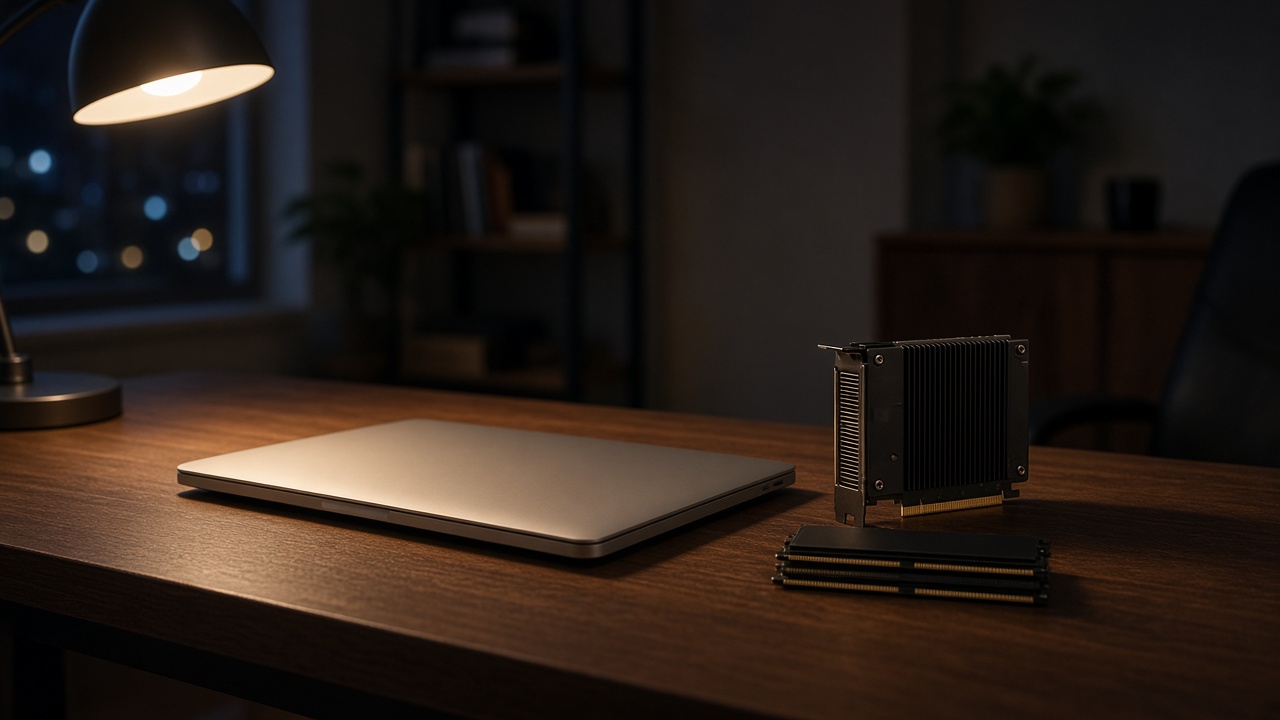
The picture above is ours. We have not run either model.
The model doc ↗ says both are latent mixture-of-experts models derived from Qwen3.8-Flash-Next, running on edge0-strata, a fork of Strata, through edge0-infer. The Q3_K card ↗ lists 145B parameters, 10.12B active per token, 48 layers, 512 experts, 10 routed plus 1 shared expert active per token, a 256K context, and native 4-bit training. Q3_K weights are 40.81 GiB. NVFP4 weights are 47.79 GiB. Edge0-120B on that doc is 120B parameters, 8.64B active, 27.98 GiB for Q3_K and 32.96 GiB for NVFP4. The launch post and the model doc disagree on 120B's DeepSWE and Terminal-Bench scores, so those scores are left out.
The launch post calls this open-source. The card puts Edge0-specific contributions under the Edge0 Community Model License 1.0 and leaves Qwen materials under the Qwen Community License 1.0. It permits personal use, research, modification, noncommercial sharing, internal use, and commercial use of outputs. Selling the model, a commercial model service, or an independent commercial coding or office assistant needs a written Edge0 license. The launch post's integration contact is contact@autoark.ai.
Edge0's requirements table lists 29GB peak memory, 1,100+ tokens/s prefill, 80+ tokens/s decode, about 120W, and a 128K–256K context, and says that supports a compatible laptop such as a MacBook Pro, including "local use on a 48GB laptop." A later paragraph in the same post says 28GB peak memory. The FAQ repeats 29GB. Both memory lines are Edge0's.
The same post's benchmark table says Edge0, Qwen, DeepSeek, and Claude scores come from Edge0's internal evaluations. On that table, Edge0-145B versus Qwen3.8-Flash-Next:
| Check | Edge0-145B vs Qwen3.8-Flash-Next |
|---|---|
| DeepSWE 1.1 | 64.6 vs 58.7 |
| Terminal-Bench 2.1 | 86.52 vs 83.3 |
| HLE | 35.4 vs 35.9 |
| GPQA-Diamond | 90.4 vs 91.7 |
| IFBench | 80.6 vs 81.3 |
| AA-LCR | 79.3 vs 79.1 |
Edge0-145B leads that base model on DeepSWE, Terminal-Bench, and AA-LCR, and trails it on HLE, GPQA-Diamond, and IFBench. The model doc rounds Terminal-Bench to 86.5. Claude-Opus-4.6 (Max) scores 78.2 there. The post's six-benchmark mean is 72.8 versus 71.7, with the Qwen 4-bit footprint of about 70GB marked as an estimate.
Agent decode from the Q3_K card, which matches the model doc. These are Edge0's tok/s figures:
| Machine | Agent decode |
|---|---|
| RTX 5090 D 24GB, Q3_K | 121.2 tok/s |
| RTX 4090 24GB, Q3_K | 91.7 tok/s |
| Apple M2 Ultra, Q3_K | 57.0 tok/s |
| Same 5090 D, 16 GiB VRAM and 20 GiB RAM cap, Q3_K | 44.9 tok/s |
The card says the capped row is the same RTX 5090 D, with VRAM limited by --vram-reserve-mib 8192 and RAM limited by a 20G cgroup, and that those caps are test limits, not minimums. No row is a laptop. NVFP4 on that 5090 D is 98.3 tok/s agent decode.
With residency on, the card says that 5090 D holds the 40.81 GiB Q3_K weights as 23.14 GiB of VRAM plus 31.28 GiB of RAM. The capped speed row limits RAM to 20 GiB, so it is a different setup from that split. The residency line is a 24GB NVIDIA card plus about 32GB of system RAM, not a laptop test. The Q3_K folder is 40.81 GiB on disk.
The model doc requires Linux or Windows with an NVIDIA GPU and CUDA 13, or macOS on Apple Silicon with Metal. On macOS only Q3_K is supported, the Metal template uses a 32768 context, and the first start writes a file into the model folder, which has to be writable. The launch post still lists macOS, Windows, and Linux on day one.
"My RTX 5090 tests favored Qwen3.8 Flash Next UD-IQ4_XS-v31, with 151.5 vs 104.7 tok/s and 37/40 vs 35/40. I'm not recommending Edge0 yet." — Dylan Sun ↗ (@DaSun64125381), on Edge0-145B-NVFP4. He names no test for the 37/40. We have not reproduced it.
"Oh thank god. Edge0-145B means no token meter ticking while I debug, mate." — GARLOTIC ↗ (@garlotic)
"145B on a regular laptop with Edge0-145B. Somebody in IT is about to get a lot of tickets asking why the fans won't stop" — Antonio Costa ↗ (@xetgepete)
"The catch: every number is Edge0's own, and most tests used desktop cards." — Taichi U. Koren ↗ (@TauchiUKoren). That matches the speed table above.
Reddit was not reachable for this story.
Read 29GB as Edge0's peak, and read 23.14 GiB plus 31.28 GiB as the card's residency split. The fast rows are an RTX 5090 D and an RTX 4090. The Mac row is an M2 Ultra on Q3_K. Taichi's catch matches that table.
These folders are an edge0-strata stack, not a llama.cpp drop-in. The doc says edge0-infer runs them. llama.cpp 1.0 is a separate runtime. Qwen3.8-27B and Arete are the Qwen weights in our open-source LLM comparison. Qwen4 Max Preview is not a download. The table's DeepSeek column is V4-Flash-0731, not V4.1 Flash Ultrafast. Inkling 2 Small lists a 500GB VRAM floor.
Skip it as a drop-in for a paid coding agent until a run you trust covers your own tasks. Dylan's RTX 5090 note is the only hands-on result here, and it favored his Qwen quant on speed. A commercial coding assistant also hits the license line on the card. For a hosted agent, start with the Claude Code review, Codex vs Claude Code, and cheaper Claude Code alternatives. Edge0 is not in the local LLM guide yet.